Every Shopify or WooCommerce store owner knows the headache of juggling support messages from Messenger, WhatsApp, Instagram, and more, all while customers expect answers in seconds. Meeting buyers where they already interact builds trust—and prevents abandoned carts. With multi-channel AI support, you can automate instant responses across every major platform, maximizing reach while preserving your unique brand voice. This guide shows how to deliver seamless conversations, reduce manual workload, and connect data for smarter decisions—without losing the human touch.
Table of Contents
- What Multi-Channel AI Support Involves
- Comparing Messaging Platforms and Chat Widgets
- How AI Agents Automate Customer Journeys
- Integration, Compliance, and Common Pitfalls
- Costs, Benefits, and Human Escalation Options
Key Takeaways
| Point | Details |
| Multi-Channel AI Integration | Deploy AI across various platforms to meet customers where they are for enhanced engagement. |
| Automation Improves Efficiency | AI agents handle repetitive tasks, allowing human teams to focus on complex customer needs. |
| Data-Driven Decisions | Analyze channel performance and customer interactions to optimize sales and support strategies. |
| Careful Implementation is Key | Start with a few channels, test thoroughly, and expand based on refined AI performance. |
What Multi-Channel AI Support Involves
Multi-channel AI support means deploying intelligent chatbots across every platform where your customers already spend time. Instead of forcing customers to contact you through one channel, you meet them where they are.
Your AI agents operate simultaneously on multiple touchpoints:
- Messenger for Facebook users who prefer chat bubbles
- WhatsApp for customers using this ubiquitous messaging app
- Instagram direct messages for younger demographics and visual shoppers
- Email for formal inquiries and documentation
- Your website via chat widget for visitors browsing products
- SMS for time-sensitive order updates and promotions
When a customer asks about product details on Instagram, your AI agent responds instantly with the same knowledge base. If they continue the conversation on WhatsApp hours later, the context transfers seamlessly. No repetition. No frustration.
How It Actually Works
Your AI agent connects to your e-commerce backend in real-time. It retrieves live inventory, processes coupon codes, looks up order status, and even initiates returns without human intervention. When something exceeds its capability, it escalates smoothly to your support team.
The agent learns your products, policies, and brand voice. When implemented through intelligent automation platforms, it handles repetitive questions while gathering customer intent data that informs future decisions.
Key capabilities include:
- Answering product questions with current specifications and availability
- Guiding customers through checkout with personalized recommendations
- Retrieving order details and tracking information instantly
- Processing returns or applying promotional codes without delays
- Collecting feedback and routing complex issues to humans
- Operating in multiple languages across global markets
Why This Matters for Your Store
Customers expect instant responses. A 2-hour wait for an email reply drives them to your competitor. Multi-channel deployment reduces response time from hours to seconds, across every platform simultaneously.
You eliminate the hiring and training burden of managing customer service across separate channels. One AI agent handles all of it, 24/7, without fatigue or sick days.
Deploy once, serve everywhere. That’s the efficiency gain that transforms customer experience and frees your team for high-value work.
The data flows back to you too. You see which channels drive actual purchases, which questions customers ask most, and where your product descriptions fall short.
Pro tip: Start with your top two customer channels (likely your website and Messenger), optimize the experience there, then expand to additional platforms once you’ve refined your AI agent’s responses and handoff processes.
Comparing Messaging Platforms and Chat Widgets
Not all channels are created equal. Each messaging platform has different strengths, user behaviors, and conversion patterns. Understanding these differences helps you prioritize where to deploy your AI agents first.
Platform-Specific Strengths
WhatsApp dominates in many markets outside North America, with over 100 million daily active users in regions like Europe, Latin America, and Asia. Customers on WhatsApp expect business communication, making it ideal for order updates and support queries.
Messenger reaches Facebook’s 3 billion monthly users, capturing casual browsers and shoppers who already engage with your brand there. The platform supports rich media, making product showcases seamless.
Instagram direct messages work best for visual products—fashion, beauty, home goods. Younger customers prefer this channel, and the platform’s shopping features integrate naturally with your catalog.

Your website chat widget captures intent at the moment of decision. Visitors actively browsing products or viewing checkout pages represent high-value opportunities. Consumer preferences for conversational agents show that on-site chat significantly impacts purchase completion rates.
Here’s how the most popular customer messaging channels differ for e-commerce engagement:
| Channel | Primary User Demographics | Key Business Advantage | Typical Conversation Purpose |
| Messenger | Broad, Facebook users (all ages) | Huge reach via social presence | Product questions, casual support |
| International, all age groups | Real-time updates, reliable | Order status, confirmations | |
| Instagram Direct | Younger, visual shoppers | Visual marketing, discovery | Product inquiries, catalog sharing |
| Website Chat | Active site visitors, all ages | High-purchase intent, control | Checkout help, conversion support |
| SMS | Diverse, mobile-first consumers | Urgent alerts, accessibility | Shipping notices, promotions |
| Formal, older and business users | Documentation, detailed support | Receipts, escalations, returns |
Chat Widget Advantages
Chat widgets live on your property. You own the conversation data. You control the design, timing, and messaging without platform restrictions.
Widgets reduce friction at critical moments:
- Visitor lands on product page with questions
- AI agent answers instantly
- Customer proceeds to checkout without abandoning
You avoid platform algorithm changes, fees, or policy shifts that could disrupt your support strategy. The widget works offline too, queuing messages for later responses.
The Trade-off Between Reach and Control
Messaging platforms give you massive reach. Customers already use them daily. They expect notifications and don’t require installing anything new.
But platforms own the experience. Facebook could change Messenger’s API tomorrow. WhatsApp charges per message in some regions. Instagram’s algorithm decides visibility.
Deploy on messaging platforms for reach, use your chat widget for conversion. They work together, not in competition.
The best strategy combines both. Your widget handles purchase-critical conversations on your website. Messaging platforms nurture relationships before and after the sale.
Choosing Your Starting Channels
Analyze your current customer mix:
- Where do you get most traffic?
- Which channels drive actual revenue?
- Where do support inquiries come from?
- What’s your geographic customer base?
If 60% of visitors come through Facebook, deploy Messenger first. If your customers skew younger, prioritize Instagram. If you sell internationally, WhatsApp becomes critical.
Pro tip: Start by adding your website chat widget immediately—it captures high-intent customers already on your site—then expand to your top two messaging platforms based on where your actual sales originate, not where you think customers should be.
How AI Agents Automate Customer Journeys
Automation doesn’t mean removing the human touch. It means handling repetitive tasks so your team focuses on relationships. AI agents guide customers through predictable steps, then escalate when judgment calls matter.
Think of it as a two-act play. Act one: AI handles discovery, answers, and transaction. Act two: Humans manage exceptions, build loyalty, and solve complex problems.
The Journey Before AI
Traditional customer journeys look like this: A visitor arrives, browses products, asks a question via email, waits hours for a response, loses interest, bounces. You lose the sale to a competitor with faster support.
Manual processes create bottlenecks at every stage. Your team gets overwhelmed during sales peaks. Slower response times hurt conversion rates. Customers feel forgotten.
How AI Transforms Each Stage
Discovery Stage: Your AI agent greets visitors and understands intent instantly. “I’m looking for a winter jacket in size large.” The agent pulls matching products, filters by price and rating, and presents three options within seconds.
Consideration Stage: Customers ask detailed questions. The agent retrieves inventory, explains fabric composition, compares features, applies personalized discounts. AI-driven product recommendations increase average order value by guiding customers toward complementary items.
Purchase Stage: The AI removes friction. It applies coupon codes, calculates shipping, secures the transaction. No “add to cart and wait” moment where doubt creeps in.
Post-Sale Stage: Order tracking, return processing, reorder reminders. Your agent handles these without involving your team.
Where Escalation Happens
Your AI knows its limits. A customer upset about a delayed shipment needs empathy. Complex warranty claims need judgment. Customization requests require creativity.
The agent escalates these to humans with context already gathered:
- Customer history and past purchases
- What the customer already tried
- Specific problem details
- Sentiment analysis (frustrated vs. curious)
Your support team starts informed, not starting from scratch.
Automation handles volume. Humans handle value. Combine them, and response times drop while satisfaction rises.
Real Impact Numbers
Stores using multi-channel AI agents see:
- 80% reduction in response time
- 40% increase in conversion rates
- 60% fewer support tickets (handled by AI)
- 3x more customer interactions your team can handle
Your small support team suddenly scales without hiring.
Pro tip: Map your exact customer journey from browsing to post-purchase, identify the three most common friction points, and deploy your AI agent to handle those first—quick wins build momentum before tackling complex automations.
Integration, Compliance, and Common Pitfalls
Deploying AI agents across multiple channels sounds simple until technical reality hits. Your Shopify store, email system, WhatsApp gateway, and Facebook Messenger all need to talk to each other. They don’t naturally. That’s where integration challenges emerge.
Technical Integration Challenges
Your systems hold data in different formats and locations. Customer purchase history lives in Shopify. Support tickets sit in your email. Conversation history exists on Facebook’s servers. Bringing this data together requires careful orchestration.
Common integration obstacles include:
- APIs that don’t play nicely together
- Delayed data synchronization (customer info reaches your AI hours late)
- Lost context when customers switch channels mid-conversation
- Inventory conflicts when multiple channels claim the same stock
- Payment processing inconsistencies across platforms
Data silos prevent your AI from seeing the full customer picture. The agent doesn’t know the customer bought from you last month. It doesn’t know about their previous support tickets. This leads to repetitive questions and frustrated customers.
Compliance and Data Privacy Concerns
If your customers span multiple countries, you face different legal frameworks. The European Union’s GDPR is strict. California’s CCPA adds another layer. Many countries have their own data protection rules.
Data privacy laws and system interoperability create major compliance hurdles when deploying AI across borders. Your AI agent can’t retain customer conversations indefinitely. It can’t share data with third-party platforms without explicit consent. It must allow customers to request and delete their data.
Your AI platform must handle this automatically. If your chatbot accidentally violates GDPR, you face fines up to 20 million euros or 4% of annual revenue, whichever is higher.
Transparency and Fairness Issues
Customers need to know they’re talking to AI, not a person. If your agent claims to be human or hides its nature, you lose trust instantly. Regulations increasingly require disclosure.
AI transparency and fairness in omnichannel interactions prevent bias in recommendations and unfair treatment of customer groups. Your AI shouldn’t give premium discounts only to certain demographics or deny support based on payment history.
Common Deployment Pitfalls
Stores often make these mistakes:
- Launching on all channels simultaneously (overwhelming your team with escalations)
- Poor training data (AI learns from biased or incomplete product information)
- No fallback plan when AI fails (customers get stuck, no human takes over)
- Ignoring analytics (deploying agents blindly without measuring impact)
- Insufficient escalation paths (complex issues pile up with no resolution)
Integration done wrong creates more problems than it solves. Start narrow, test thoroughly, then expand.
Before You Deploy
Audit your systems. Map where customer data lives. Identify compliance requirements for your markets. Test integrations in staging environments. Document escalation procedures. Train your team on new workflows.
Pro tip: Begin by integrating your AI agent with just your website chat widget and one messaging platform, run it for two weeks, measure response times and escalation rates, fix issues, then add additional channels once your foundation is solid.
Costs, Benefits, and Human Escalation Options
AI agents aren’t free, but neither is hiring support staff. The math works differently depending on your store size. A five-person operation sees different ROI than a 50-person team. Understanding the actual numbers helps you decide.
Real Costs You’ll Face
Initial setup varies widely. Some platforms charge monthly subscriptions ($500 to $5,000 depending on features). Integration work might require a developer ($2,000 to $10,000). Training your team takes time and focus.
Monthly ongoing costs include:
- Platform subscription (usually $500 to $3,000)
- API usage fees for third-party integrations
- Training data maintenance and updates
- Occasional escalation ticket reviews
These aren’t huge numbers for most stores. A subscription platform costs less than one full-time support employee.
Benefits That Offset Costs
Cost savings through automation and sales efficiency come from multiple angles. Your AI agent handles 60 to 80 percent of inquiries without human involvement. That alone reduces support payroll dramatically.
Additional gains include:
- Faster response times (seconds instead of hours)
- Higher conversion rates (fewer abandoned carts)
- Reduced support ticket volume
- 24/7 availability without hiring night shift staff
- Better customer data for marketing decisions
- Fewer repetitive questions eating your team’s time
Stores typically see payback in 3 to 6 months.
To help you assess the return on investment from multi-channel AI agents, here’s a summary of key performance metrics:
| Metric | Typical Improvement Target | Business Outcome |
| Response Time | 80% faster | Higher customer satisfaction |
| Conversion Rate | 15-25% increase | More sales, fewer abandoned carts |
| AI-Handled Support | 65-75% of tickets resolved | Lower staffing costs, scalability |
| Cost per Ticket | 70% reduction | Major savings over human support |
| Payback Period | 3-6 months | Fast ROI for most stores |
Human Escalation: Your Safety Net
Your AI will hit limits. Angry customers. Unusual requests. Edge cases. That’s when humans take over.
Effective human escalation protocols maintain customer trust and satisfaction when AI reaches its limits. A smooth handoff feels seamless to the customer. A clumsy one feels like punishment.
Key escalation components:
- Automatic detection when AI confidence drops below threshold
- Warm transfers with full conversation context
- Priority routing (urgent issues go to senior agents)
- Time limits (escalated tickets answered within 30 minutes)
- Feedback loops (learn why AI failed)
Structuring Escalation Teams
You don’t need the same staff size. One agent can now handle three times more conversations because AI filters out the easy stuff.
Instead of “customer service,” think “exception handling.” Your team focuses on customers the AI flagged as frustrated, complex, or high-value. This is better work. Higher satisfaction. Less burnout.
AI handles volume. Humans handle nuance. This combination costs less than either alone.
Small stores might keep one part-time escalation person. Larger operations might maintain a dedicated tier-two team. The key is knowing your thresholds in advance.
Measuring ROI
Track these metrics from day one:
- Support tickets resolved by AI (target: 65-75%)
- Average response time (target: under 2 minutes)
- Customer satisfaction scores (target: 4.2+ out of 5)
- Conversion rate improvement (target: 15-25% increase)
- Cost per resolved ticket (target: 70% reduction)
If you’re not hitting these after two months, something needs adjustment.
Pro tip: Calculate your current cost per support ticket by dividing total support payroll by monthly ticket volume, then compare it to AI platform costs—the difference is your immediate savings potential before factoring in conversion improvements.
Elevate Your Ecommerce with Multi-Channel AI Support from Agenized
The article highlights the critical challenges online stores face today: delivering instant, seamless customer support across multiple platforms while managing operational costs and maintaining exceptional service quality. If delays, inconsistent responses, or overwhelming support tickets are hurting your sales and customer satisfaction, you are not alone. Using terms like “multi-channel deployment” and “escalation to human agents,” the article uncovers how AI can transform customer journeys by meeting buyers where they are and handling routine tasks efficiently.
Agenized offers precisely the solution your store needs to overcome these pain points. Our AI-powered sales and support agents operate across Messenger, WhatsApp, Instagram, Gmail, and your website via the Agenized Chat Widget ensuring real-time, contextual replies with smooth human escalation whenever necessary. You get customizable agent templates, GDPR-compliant workflows, multi-language support, and easy integration with Shopify, WooCommerce, or Magento. This means faster responses, fewer abandoned carts, and a more satisfied customer base—without the heavy cost of expanding your support team. Discover how to automate smartly and boost conversion rates now by exploring Agenized’s powerful platform.
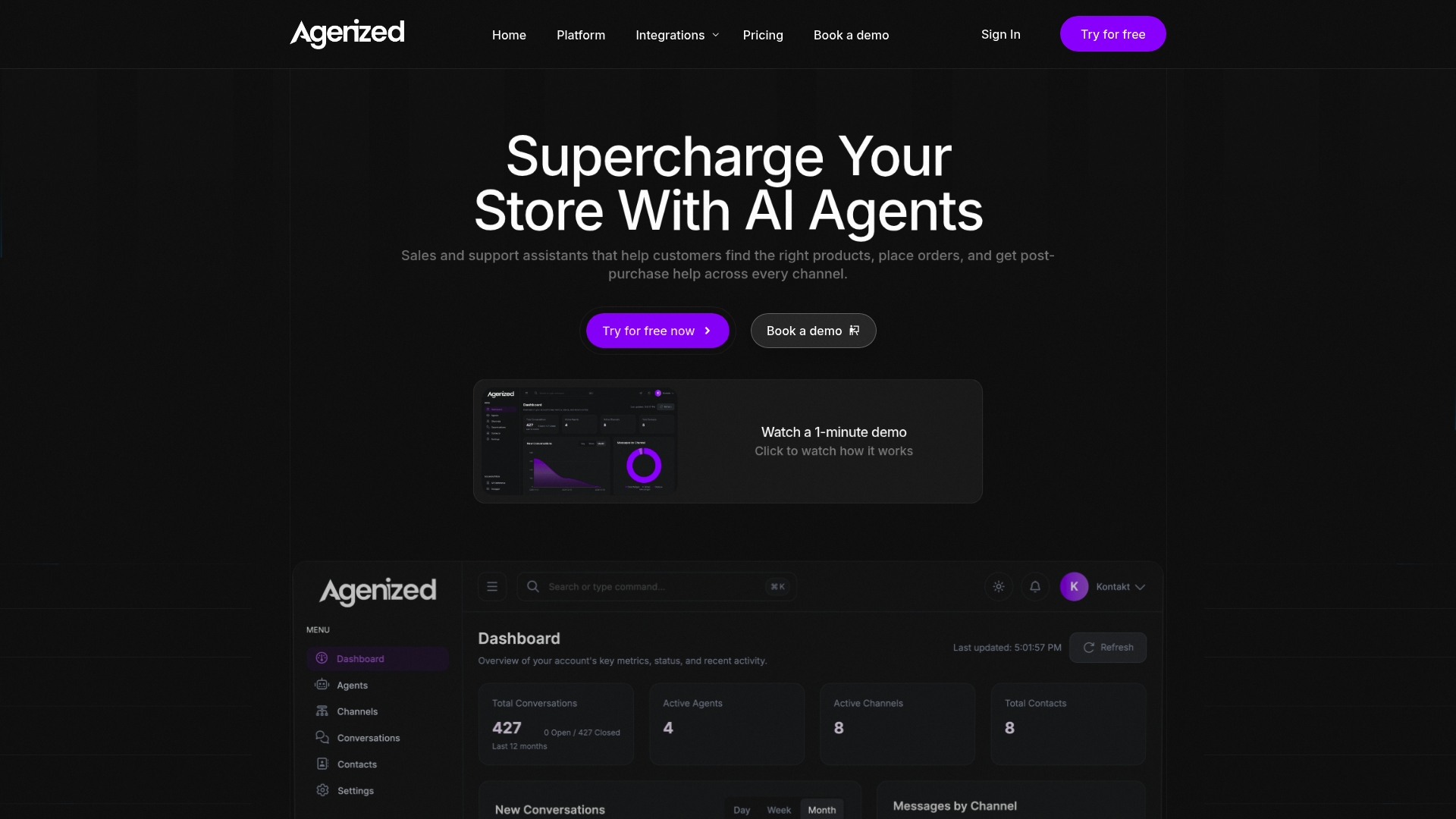
Ready to transform your ecommerce sales experience with true multi-channel AI support Deploy your own intelligent agents today and watch your customer engagement and revenue grow effortlessly Start your journey with Agenized and unlock the future of ecommerce support now.
Frequently Asked Questions
What is multi-channel AI support?
Multi-channel AI support refers to using intelligent chatbots across various platforms where customers interact, allowing businesses to engage customers on their preferred channels, such as Messenger, WhatsApp, Instagram, email, website chat, and SMS.
How does an AI agent enhance customer interaction?
An AI agent enhances customer interaction by providing instant responses to inquiries, retrieving real-time information about products and orders, processing returns, and applying promotional codes without human intervention, thus reducing response times significantly and improving customer experience.
Why is it important to use multiple messaging platforms for customer support?
Using multiple messaging platforms is important because each platform attracts different demographics and user behaviors. This allows businesses to reach a wider audience and engage customers where they are most active, which can lead to increased sales and customer satisfaction.
What are the key benefits of deploying an AI agent in e-commerce?
The key benefits of deploying an AI agent in e-commerce include faster response times, increased conversion rates, reduced support ticket volume, 24/7 customer service availability, and improved data collection for better marketing decisions.