Think chatbots are just automated scripts responding with canned messages? That’s outdated. Modern AI chatbots use sophisticated natural language processing and real-time data retrieval to understand customer intent, recommend products, and complete purchases. For e-commerce stores in 2026, these intelligent assistants don’t just answer questions, they drive sales, reduce support costs, and operate around the clock. This guide explains what AI chatbots truly are and why they’ve become essential for online retail success.
Table of Contents
- Understanding The Basics: What Is An AI Chatbot?
- Why E-Commerce Stores Need AI Chatbots In 2026
- Common Pitfalls And How To Ensure Chatbot Success
- How To Leverage AI Chatbots To Boost Your E-Commerce Success
- Enhance Your E-Commerce With AI Chatbots Today
Key takeaways
| Point | Details |
|---|---|
| AI chatbots boost engagement | They reduce support tickets and increase conversion rates through personalized, instant responses. |
| Advanced tech powers chatbots | Natural language processing and retrieval-augmented generation enable human-like understanding and accurate product recommendations. |
| Testing prevents failures | Rigorous AI testing ensures chatbots deliver correct answers, maintain brand voice, and protect customer privacy. |
| Human balance remains crucial | 70% of customers still prefer human agents for complex issues, requiring smart escalation strategies. |
| 24/7 availability drives sales | Round-the-clock operation reduces cart abandonment and personalizes shopping experiences at scale. |
Understanding the basics: what is an AI chatbot?
An AI chatbot is an intelligent virtual assistant that uses artificial intelligence to communicate naturally with your customers. Unlike rule-based bots that follow rigid scripts, modern AI chatbots understand context, interpret intent, and deliver personalized responses.
Natural Language Processing (NLP) is the core technology behind AI chatbots, enabling them to comprehend human language nuances. When a customer types “I need a gift for my mom,” the chatbot doesn’t just match keywords. It understands the intent, asks clarifying questions, and suggests relevant products based on that context.
Retrieval-augmented generation (RAG) takes this further. LLM-powered chatbots with RAG access your real-time product catalog, inventory levels, and customer data to generate accurate, current responses. Instead of providing outdated information, they pull fresh data every time they answer.
AI chatbots perform multiple functions in e-commerce:
- Answer product questions and provide detailed specifications
- Recommend items based on browsing history and preferences
- Process orders and apply discount codes
- Track shipments and handle post-purchase inquiries
- Escalate complex issues to human agents when needed
Pro Tip: Choose chatbots powered by modern AI technology rather than rule-based systems. The difference in customer experience is dramatic. Rule-based bots frustrate customers with rigid conversation flows, while AI-powered assistants adapt to natural conversation patterns and deliver genuinely helpful responses. For implementation guidance, explore our step by step AI agent workflow for e-commerce.
Why e-commerce stores need AI chatbots in 2026
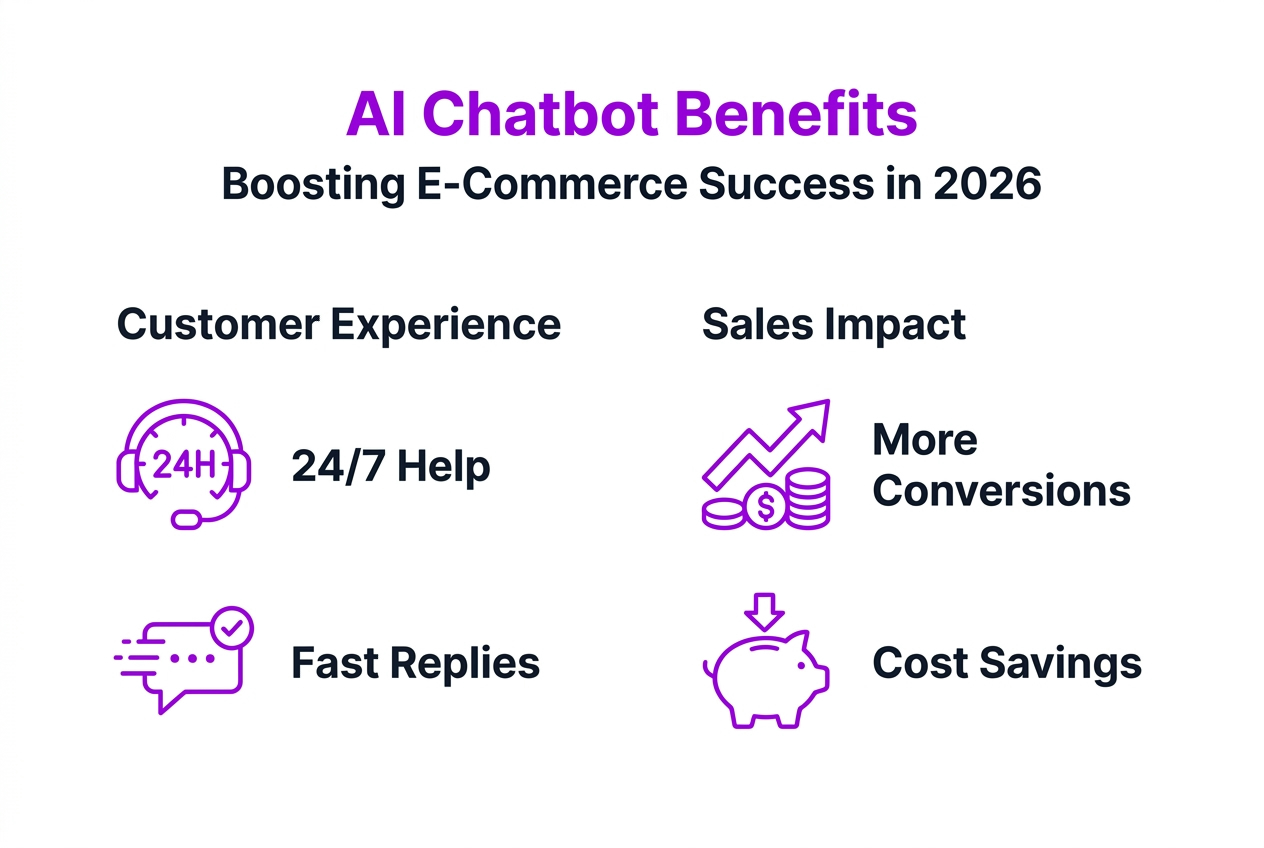
The numbers tell a compelling story. AI-powered chatbots enhance customer engagement and automate support in online retail. Stores implementing AI chatbots see support tickets reduced by 68% while conversion rates jump 23%.
These gains come from AI chatbots operating 24/7 without breaks or holidays. When a customer lands on your store at 2 AM with questions, the chatbot engages immediately. No wait times, no frustration, just instant personalized assistance that keeps them moving toward purchase.

| Metric | Before Chatbot | After Chatbot | Change |
|---|---|---|---|
| Monthly Support Tickets | 2,500 | 800 | -68% |
| Conversion Rate | 2.1% | 2.6% | +23% |
| Average Response Time | 4.2 hours | Instant | -100% |
| Customer Satisfaction | 72% | 89% | +17% |
Cart abandonment remains a massive challenge for online retailers. The average cart abandonment rate across all industries hits 69.82%. AI chatbots combat this by proactively engaging customers who hesitate at checkout, answering last-minute questions about shipping, returns, or product details that might otherwise derail the sale.
Key benefits for e-commerce stores include:
- Dramatic cost savings on customer support staff and infrastructure
- Increased sales through personalized product recommendations
- Better customer experience with instant, accurate responses
- Round-the-clock availability across all time zones
- Scalability to handle traffic spikes during promotions without adding staff
The financial impact extends beyond support savings. When chatbots guide customers to products that genuinely match their needs, average order values rise. They cross-sell complementary items naturally within conversation flow, boosting revenue per transaction. Learn more about customer engagement strategies that boost e-commerce sales or dive into specific tactics to boost e-commerce sales with AI chatbots.
Common pitfalls and how to ensure chatbot success
Not all AI chatbot deployments succeed. Many eCommerce chatbots fail due to insufficient AI testing, leading to incorrect answers, broken conversation flows, and frustrated customers.
Common failures include:
- Inadequate testing before launch, resulting in chatbots that can’t handle real customer questions
- Incorrect product information or pricing due to outdated training data
- Conversation flows that trap customers in loops without resolution
- Privacy violations when chatbots access or share sensitive customer data inappropriately
- Inconsistent brand voice that feels robotic or off-brand
AI testing ensures your chatbot delivers accurate responses, maintains compliance with privacy regulations like GDPR, and speaks in your brand’s authentic voice. This means running thousands of test conversations covering edge cases, unusual questions, and complex scenarios before customers ever interact with the bot.
Balancing AI with human support remains critical. Research shows 70% of consumers still prefer human agents for customer service interactions, especially for complex issues involving complaints, refunds, or technical problems. Your chatbot needs smart escalation logic that recognizes when human intervention would serve the customer better.
“42% of British consumers admit they are ruder to AI chatbots compared to human beings, and this rude behavior often leads to customer churn when chatbots fail to handle the interaction gracefully.”
This statistic highlights a real challenge. When customers grow frustrated with chatbots, they express that frustration more harshly than they would with humans. If your chatbot can’t handle that friction or recognize escalation signals, you lose sales and damage brand perception.
Pro Tip: Continuously monitor chatbot conversations and collect user feedback to identify pain points. Set up weekly reviews of failed conversations where the bot couldn’t help or customers expressed frustration. Use these insights to refine responses, expand training data, and adjust escalation triggers. Successful chatbot programs treat launch as the beginning of optimization, not the end. Explore best practices for online customer service with AI chatbots to maximize satisfaction.
How to leverage AI chatbots to boost your e-commerce success
Implementing AI chatbots effectively requires strategic planning and execution. Follow these steps:
- Select the right AI technology platform that integrates with your e-commerce system (Shopify, WooCommerce, Magento)
- Train the chatbot on your complete product catalog, FAQs, and brand guidelines
- Configure conversation flows for common customer journeys like product discovery, checkout assistance, and order tracking
- Conduct thorough AI testing across multiple scenarios, devices, and customer segments
- Launch with monitoring tools to track performance metrics and customer satisfaction
- Continuously optimize based on real conversation data and customer feedback
Chatbots operate 24/7 to provide customer services, answer questions, complete transactions, and offer personalized recommendations. This constant availability directly addresses cart abandonment, which hits 69.82% across industries. When customers have questions at checkout, instant chatbot responses keep transactions moving forward.
| Feature | AI Chatbot | Traditional Support |
|---|---|---|
| Availability | 24/7/365 | Business hours only |
| Response Time | Instant | Minutes to hours |
| Personalization | Real-time product recommendations | Generic responses |
| Cost per Interaction | $0.02 – $0.10 | $5 – $15 |
| Scalability | Unlimited concurrent chats | Limited by staff size |
| Consistency | Identical quality always | Varies by agent |
AI chatbots excel at personalized product recommendations by analyzing browsing history, previous purchases, and stated preferences. When a customer asks for running shoes, the chatbot considers their past orders, size, budget mentions in the conversation, and current inventory to suggest the perfect options. This beats generic product filtering by creating a curated shopping experience.
For order processing, chatbots handle routine tasks like applying coupon codes, checking order status, initiating returns, and updating shipping addresses. This frees your human team to focus on complex issues requiring judgment, empathy, or creative problem solving.
Deepen your understanding with resources on 24/7 customer support in e-commerce and discover how AI product discovery boosts sales by 30%.
Enhance your e-commerce with AI chatbots today
You’ve learned what AI chatbots are, why they transform e-commerce performance, and how to implement them successfully. Now it’s time to put that knowledge into action.
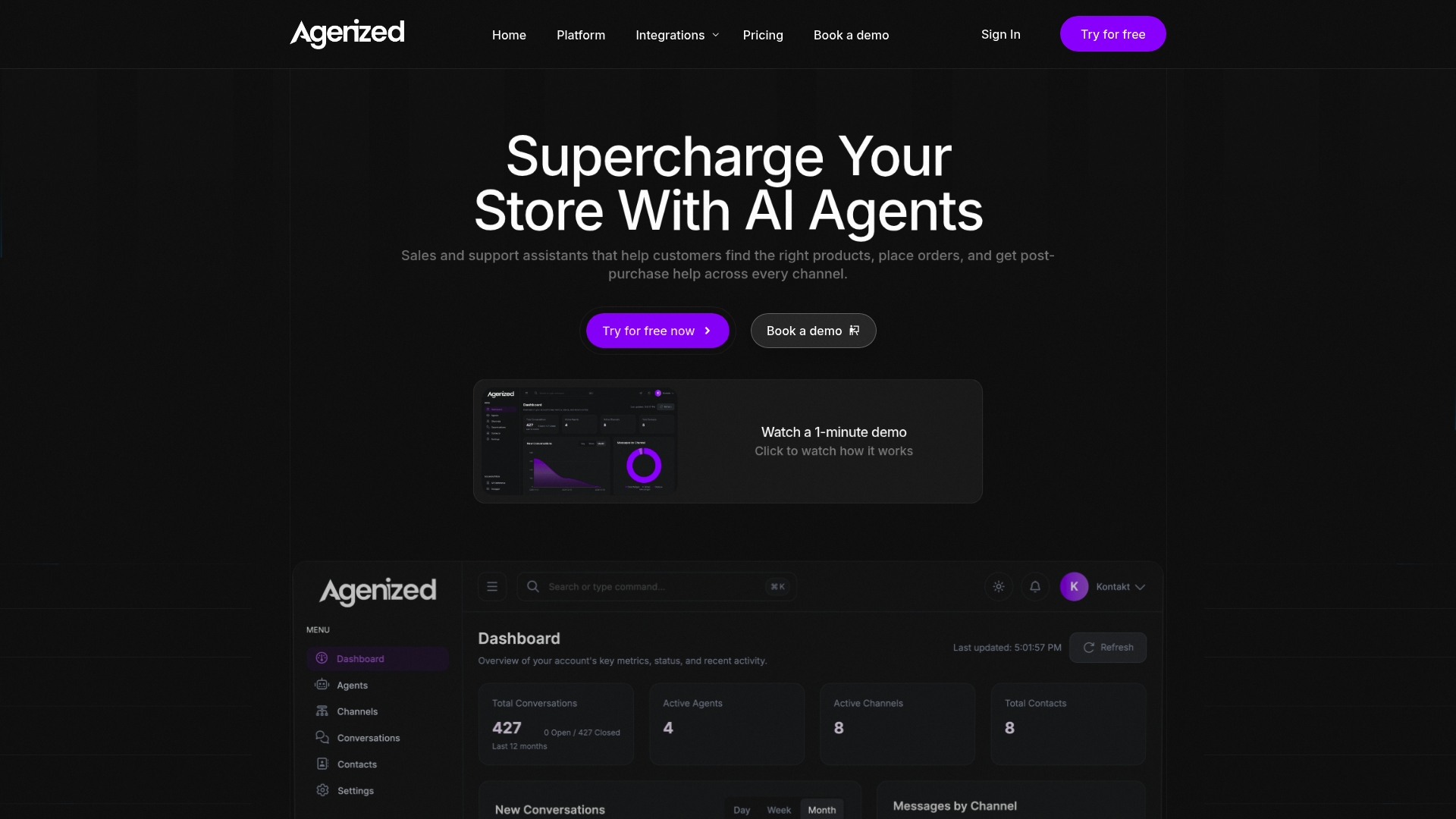
Agenized specializes in AI-powered sales and support agents built specifically for online retailers. Our platform delivers:
- Seamless integration with Shopify, WooCommerce, and Magento stores
- Advanced AI capabilities powered by natural language processing and real-time data retrieval
- Personalized product recommendations that increase average order values
- 24/7 support automation across multiple channels including your website, WhatsApp, and Instagram
- Easy-to-use visual builders requiring no coding expertise
Explore the Agenized platform to see how our AI agents transform customer interactions. Whether you’re looking to boost e-commerce sales with AI chatbots or implement comprehensive 24/7 customer support, Agenized provides the technology and expertise to help your store succeed.
What is an AI chatbot? Frequently asked questions
What types of questions can AI chatbots answer for customers?
AI chatbots handle product specifications, sizing information, availability checks, shipping timelines, return policies, and order tracking. They also provide personalized recommendations based on customer preferences and answer common pre-purchase questions that might prevent conversions.
How do AI chatbots handle complex or unusual customer requests?
Modern AI chatbots use natural language processing to understand context and intent, even for unconventional questions. When requests exceed their capabilities or require human judgment, smart chatbots recognize the limitation and seamlessly escalate to human agents with full conversation context.
Can AI chatbots replace human customer service representatives entirely?
No, and they shouldn’t. While AI chatbots excel at routine inquiries and transactions, 70% of consumers prefer human agents for complex issues. The optimal approach combines AI efficiency for common questions with human expertise for situations requiring empathy, judgment, or creative problem solving.
What are the key benefits of AI chatbots for smaller online stores?
Smaller stores gain 24/7 customer coverage without hiring night shift staff, handle traffic spikes during promotions without overwhelm, reduce support costs by automating routine questions, and compete with larger retailers on customer experience. AI chatbots level the playing field by providing enterprise-quality service at accessible price points.
How often should I update and test my AI chatbot after launch?
Review chatbot performance weekly during the first month, then bi-weekly as performance stabilizes. Update training data whenever you add products, change policies, or notice recurring questions the bot struggles to answer. Run comprehensive testing before major sales events or catalog updates to ensure accurate responses.