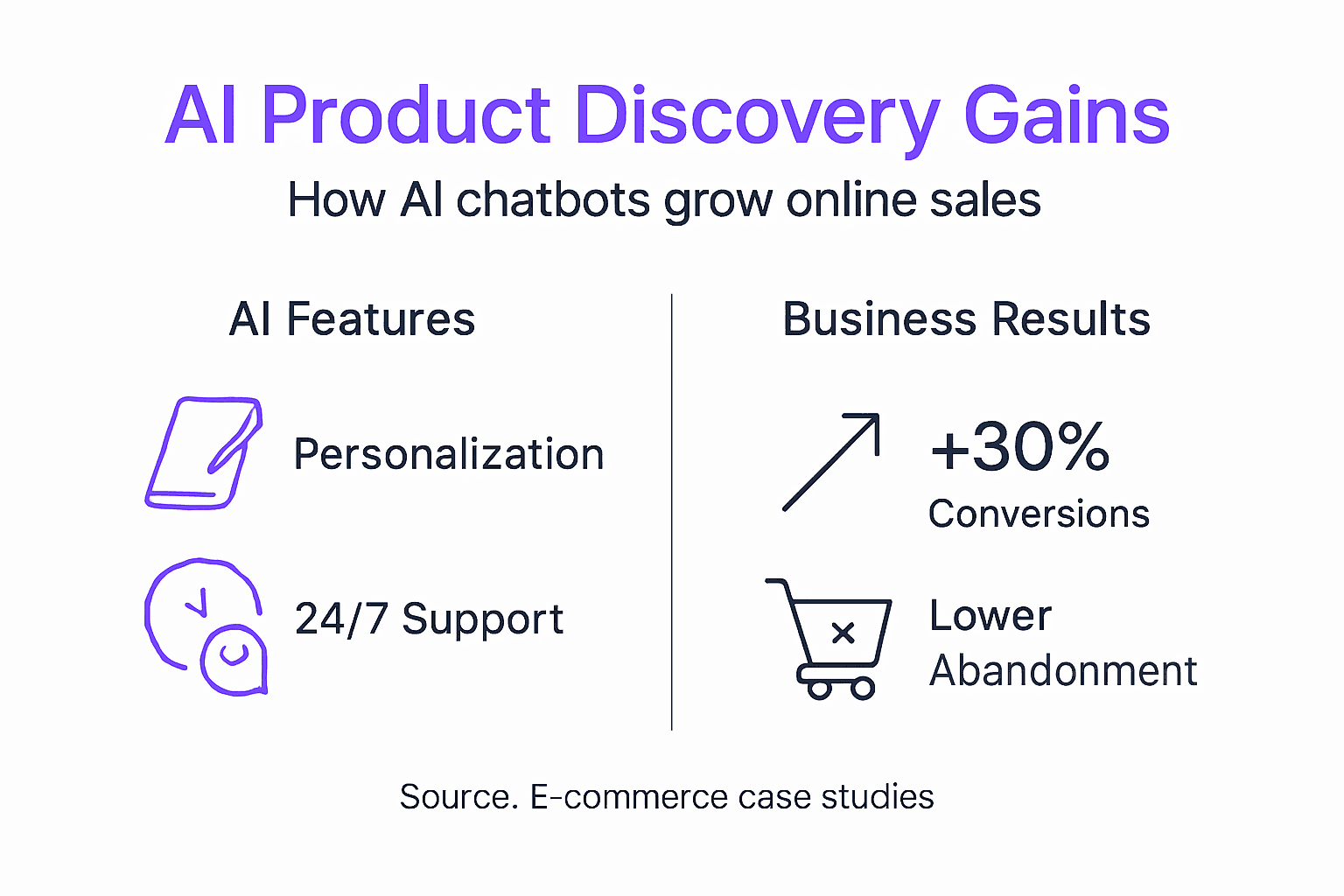
AI chatbots are transforming how online stores connect shoppers with products. Conversion rates improved by up to 30% in stores using AI chatbots for product discovery, addressing a critical challenge where traditional search and filtering leave customers overwhelmed and ready to abandon their carts. This guide shows you how AI-powered product discovery works, what measurable benefits you can expect, and how to deploy these tools to increase sales and customer satisfaction in your e-commerce store.
Table of Contents
- Introduction To AI In Product Discovery
- How AI Chatbots Enhance Product Discovery Mechanisms
- Quantifiable Benefits Of AI-Powered Product Discovery
- Common Misconceptions About AI Chatbots In E-Commerce
- Comparing AI Chatbot Solutions: What To Look For
- Implementing AI Chatbots For Effective Product Discovery
- Conclusion: Unlocking Sales Growth With AI-Driven Product Discovery
- Enhance Your E-Commerce Product Discovery With Agenized AI Chatbots
Key takeaways
| Point | Details |
|---|---|
| AI chatbots use NLP to personalize product discovery | Natural language processing understands customer intent and delivers tailored product suggestions in real time. |
| Implementation leads to up to 30% higher conversion rates | Stores adopting AI chatbots see significant sales growth by reducing decision fatigue and cart abandonment. |
| Customization boosts recommendation accuracy by up to 15% | Tailored chatbot templates for specific product categories outperform generic solutions in customer satisfaction. |
| Multi-channel integration and privacy compliance are key for success | Effective deployment requires seamless integration across platforms like Messenger, WhatsApp, and web chat with GDPR adherence. |
| Proper deployment reduces decision fatigue and increases customer loyalty | Strategic implementation transforms browsing experiences, leading to repeat purchases and higher customer lifetime value. |
Introduction to AI in product discovery
E-commerce stores face a persistent challenge: shoppers arrive with intent but leave without buying. Low engagement and high bounce rates plague online retailers as customers struggle to find the right products among thousands of options. Traditional search bars and category filters fail to capture nuanced preferences, leaving shoppers frustrated and competitors just one click away.
AI chatbots address these pressures by acting as digital shopping assistants. AI chatbots use natural language processing (NLP) to understand customer queries contextually, enabling tailored product suggestions that significantly reduce decision fatigue. Instead of typing keywords into search boxes, customers describe what they need in plain language, and the chatbot interprets intent, preferences, and context to recommend products that truly match.
Basic AI technologies powering these chatbots include:
- Natural language processing engines that parse customer messages and extract meaning beyond literal keywords
- Personalization algorithms that analyze browsing history, purchase patterns, and demographic data to refine suggestions
- Real-time data integrations that pull inventory, pricing, and product specifications directly into conversations
These systems integrate seamlessly with digital storefronts, appearing as chat widgets on websites or messaging apps customers already use daily. By meeting shoppers where they are and speaking their language, AI chatbots transform product discovery from a search problem into a guided conversation. The result is a customer-centric experience that prioritizes finding the perfect product over forcing customers to navigate complex menus. For a deeper look at AI chatbot basics and examples, explore practical implementations across different store types.
Pro Tip: Start by identifying your three most common customer questions about products. Train your chatbot to answer these first, then expand capabilities based on actual conversation data.
How AI chatbots enhance product discovery mechanisms
Natural language processing sits at the core of effective product discovery chatbots. When a customer types “I need a gift for my mom who loves gardening,” NLP algorithms parse intent (gift shopping), recipient (mom), and interests (gardening) to narrow thousands of products to a relevant shortlist. Chatbots using NLP reduce customer decision time by 25% on average, cutting through choice paralysis that traditionally leads to abandoned sessions.
Personalized recommendations take this further by layering individual customer data onto contextual understanding. If the same shopper previously bought organic seeds, the chatbot prioritizes eco-friendly gardening tools over conventional options. This AI personalization mechanism analyzes purchase history, browsing patterns, and stated preferences to deliver suggestions that feel hand-picked rather than algorithmically generated.
Decision fatigue vanishes when choices narrow intelligently. Instead of scrolling through 200 garden tools, the customer sees five curated options with clear comparisons. The chatbot explains why each fits the criteria, highlights differences, and answers follow-up questions like “Which one is best for small spaces?” This conversational flow mimics speaking with a knowledgeable store associate, making product selection faster and more confident.
Example conversation flows demonstrate this in action:
- Customer: “I want waterproof hiking boots under $150”
- Chatbot: “I found three options: Brand A has excellent ankle support at $129, Brand B offers lightweight comfort at $139, and Brand C features extra grip for $145. Which matters most to you?”
- Customer: “Ankle support”
- Chatbot: “Perfect. Brand A fits your budget and priority. It has 4.7 stars from 230 reviews. Want to see sizing options?”
For complex queries requiring human expertise, AI chatbots collaborate with human agents through smart escalation. When a customer asks about compatibility between products or needs technical specifications beyond the chatbot’s training, it seamlessly transfers the conversation with full context, ensuring no repetition or frustration. This hybrid approach maximizes efficiency while maintaining service quality.
Pro Tip: Configure your chatbot to ask clarifying questions when customer requests are vague. “Looking for a laptop” becomes “Are you using it for work, gaming, or everyday tasks?” to deliver better recommendations faster.
Quantifiable benefits of AI-powered product discovery
Real stores see measurable gains when AI chatbots guide product discovery. Conversion rates jump as personalized recommendations connect shoppers with products they actually want. One mid-sized fashion retailer reported a 28% increase in completed purchases within three months of deploying an AI chatbot trained on their catalog and customer preferences. Another electronics store reduced average time from landing page to checkout by 40%, directly attributed to chatbot-assisted product selection.

Cart abandonment drops significantly when proactive chatbots intervene at critical moments. If a customer adds items but hesitates, the chatbot offers help: “Need sizing advice?” or “I can apply your 10% coupon now.” These timely prompts address hesitation points before customers navigate away. Stores using AI chatbots for reducing cart abandonment see recovery rates improve by 15 to 20 percentage points compared to email-only strategies.
Customer satisfaction rises when experiences feel personalized rather than transactional. Post-purchase surveys from stores with AI chatbots show satisfaction scores 18% higher than those relying solely on traditional search and filtering. Shoppers appreciate the convenience of describing needs naturally and receiving relevant suggestions without endless scrolling.
Key performance improvements include:
- Faster resolution times for product questions, averaging 90 seconds versus 8 minutes for email support
- Increased average order value as chatbots suggest complementary products based on cart contents
- Higher repeat purchase rates from customers who experienced guided shopping
Statistic Callout: Stores implementing AI chatbots see an average 30% boost in conversion rates, with some high-performing retailers reaching 35% improvement when combining chatbot guidance with real-time inventory updates and instant coupon application.
Successful case examples prove the value. A home goods store integrated an AI chatbot that asked three qualifying questions before showing product options. Within six months, they tracked a 32% conversion increase and 22% fewer returns, as better initial matches reduced buyer’s remorse. The AI chatbot impact on sales extends beyond immediate transactions to long-term customer relationships built on trust and convenience.
Common misconceptions about AI chatbots in e-commerce
Many store owners hesitate because they believe AI chatbots will replace their customer service teams entirely. This myth ignores how AI and humans work best together. Chatbots handle repetitive queries like “What’s your return policy?” or “Do you have this in blue?” freeing human agents to solve complex problems requiring empathy, negotiation, or specialized knowledge. The goal is augmentation, not replacement. Customers benefit from instant responses to simple questions while knowing a human can step in when needed.
Another misconception assumes all chatbots deliver equal results. Quality varies dramatically based on customization and integration depth. Generic chatbots trained on broad datasets struggle with niche product catalogs or industry-specific terminology. Custom AI chatbots tailored for specific categories improve recommendation accuracy and customer satisfaction by up to 15%. A chatbot built for a jewelry store understands carat weight and metal types, while one for auto parts knows compatibility by make and model.
Privacy concerns create another barrier. Some believe GDPR and similar regulations make AI chatbots impractical or legally risky. The reality is that GDPR-compliant bots build customer trust by transparently handling data. Properly configured chatbots disclose data collection, allow opt-outs, and store information securely. Compliance becomes a competitive advantage as privacy-conscious shoppers prefer stores that respect their information.
Key facts dispelling myths:
- AI chatbots complement human agents by triaging conversations based on complexity
- Customization determines effectiveness; off-the-shelf solutions rarely match tailored implementations
- Privacy compliance enhances rather than limits chatbot capabilities when built into the design
- Successful deployments require ongoing training and optimization, not just initial setup
Pro Tip: Audit your chatbot conversations monthly to identify questions it handles poorly. Use these insights to expand training data and improve accuracy, turning weak spots into strengths.
Understanding these realities helps you make informed decisions about AI chatbot adoption. The technology works when implemented thoughtfully with realistic expectations about roles, customization needs, and privacy responsibilities.
Comparing AI chatbot solutions: what to look for
Choosing the right AI chatbot requires evaluating capabilities against your specific e-commerce needs. Not all platforms offer the same features, and what works for one store type may underperform for another. This comparison framework helps you assess options systematically.
| Feature | Custom Solutions | Generic Templates | Why It Matters |
|---|---|---|---|
| Product Catalog Integration | Deep integration with SKU data, specifications, and inventory | Surface-level product name matching | Custom solutions deliver accurate recommendations based on real-time stock and detailed attributes |
| Multi-Channel Support | Native deployment across web, Messenger, WhatsApp, Instagram, email | Often limited to website widgets only | Customers expect consistent experiences across platforms they already use |
| Real-Time Actions | Execute orders, apply coupons, retrieve tracking info during conversations | Link to external pages requiring customer navigation | Completing transactions within chat reduces friction and cart abandonment |
| Privacy Compliance | Built-in GDPR, CCPA features with data handling transparency | May require manual configuration or lack compliance tools | Legal requirements and customer trust depend on proper data handling |
| Platform Compatibility | Seamless integration with Shopify, WooCommerce, Magento, custom APIs | May require technical workarounds | Ease of integration determines deployment speed and maintenance costs |
Customization versus generic templates presents a clear trade-off. Generic solutions cost less upfront but deliver average results. They lack product-specific knowledge and require customers to adapt to the chatbot’s limitations. Custom implementations cost more initially but pay dividends through higher accuracy and better customer experiences. Custom vs generic chatbot effectiveness shows tailored solutions outperform by significant margins in customer satisfaction and conversion metrics.
Multi-channel integration support matters because your customers shop across platforms. A chatbot limited to your website misses conversations happening on social media or messaging apps where customers increasingly begin their shopping journeys. Look for platforms supporting:
- Website chat widgets with customizable appearance
- Facebook Messenger and Instagram Direct integration
- WhatsApp Business API connectivity
- Email response automation
Real-time features transform chatbots from information tools to transaction engines. When a chatbot can retrieve order status, apply discount codes, or complete purchases without leaving the conversation, customer satisfaction jumps. Compare platforms on their ability to execute actions, not just provide information.
Privacy compliance should be a decision factor, not an afterthought. Platforms with built-in GDPR features handle consent, data access requests, and deletion automatically. This protects your business legally and builds customer confidence.
For detailed AI chatbot platform comparisons and guidance on selecting AI chatbot solutions, explore options tailored to e-commerce needs across different scales and specializations.
Implementing AI chatbots for effective product discovery
Successful deployment follows a structured approach that addresses technical integration, training, compliance, and optimization. Skip steps, and you risk poor performance or customer frustration. Follow this process to maximize results.
-
Assess your specific product discovery challenges by analyzing customer behavior data. Review support tickets, search queries, and cart abandonment points to identify where shoppers struggle most. Common pain points include sizing confusion, compatibility questions, and overwhelming product ranges.
-
Choose platforms supporting multi-channel deployment and real-time actions. Prioritize solutions that integrate natively with your e-commerce platform (Shopify, WooCommerce, Magento) and offer APIs for custom workflows. Verify the platform handles inventory updates, pricing changes, and promotional campaigns automatically.
-
Customize chatbot templates to your specific products and customer language. Train the AI on your catalog with detailed product descriptions, specifications, and common customer questions. Use actual customer service transcripts to teach conversational patterns your shoppers use.
-
Train and test thoroughly before public launch. Run internal tests with your team acting as customers, asking difficult questions and edge cases. Adjust responses based on performance. Beta test with a small customer segment, gathering feedback on accuracy and helpfulness.
-
Implement GDPR-compliant privacy measures from day one. Configure consent flows, data retention policies, and deletion processes. Display clear privacy notices explaining what data the chatbot collects and how you use it. Make opt-outs simple and obvious.
-
Monitor performance using specific KPIs tied to business goals. Track conversation completion rates, escalation frequency, customer satisfaction scores, and conversion rates for chatbot-assisted sessions. Compare these metrics against traditional discovery methods to measure improvement.
Integrating AI chatbots across channels requires coordinating deployment timing and messaging consistency. Launch on your highest-traffic channel first, stabilize performance, then expand. This phased approach prevents overwhelming your team while building confidence in the technology.
The chatbot platform integration process varies by e-commerce system but generally involves installing plugins, connecting APIs, and configuring product data feeds. Allocate time for technical setup and testing, typically one to three weeks depending on customization depth.
Continuous improvement separates successful implementations from abandoned projects. Schedule monthly reviews of chatbot conversations, identifying patterns in misunderstood queries or unsatisfactory responses. Update training data, expand capabilities, and refine conversation flows based on real usage. AI chatbots improve with use, becoming more accurate and helpful as they learn from interactions.
Conclusion: unlocking sales growth with AI-driven product discovery
AI chatbots fundamentally transform how e-commerce stores connect customers with products. By understanding natural language, personalizing recommendations, and guiding shoppers through decisions, these tools deliver measurable improvements in conversion rates, customer satisfaction, and average order values. Stores that implement thoughtfully see not just immediate sales growth but also stronger customer loyalty and reduced support costs. Continuous optimization and privacy compliance ensure long-term success. The competitive advantage goes to retailers who adopt AI chatbots now, building experiences that meet rising customer expectations for personalized, efficient shopping.
Enhance your e-commerce product discovery with Agenized AI chatbots
Ready to transform browsing into buying? Agenized offers customizable AI chatbot platforms designed specifically for e-commerce product discovery.
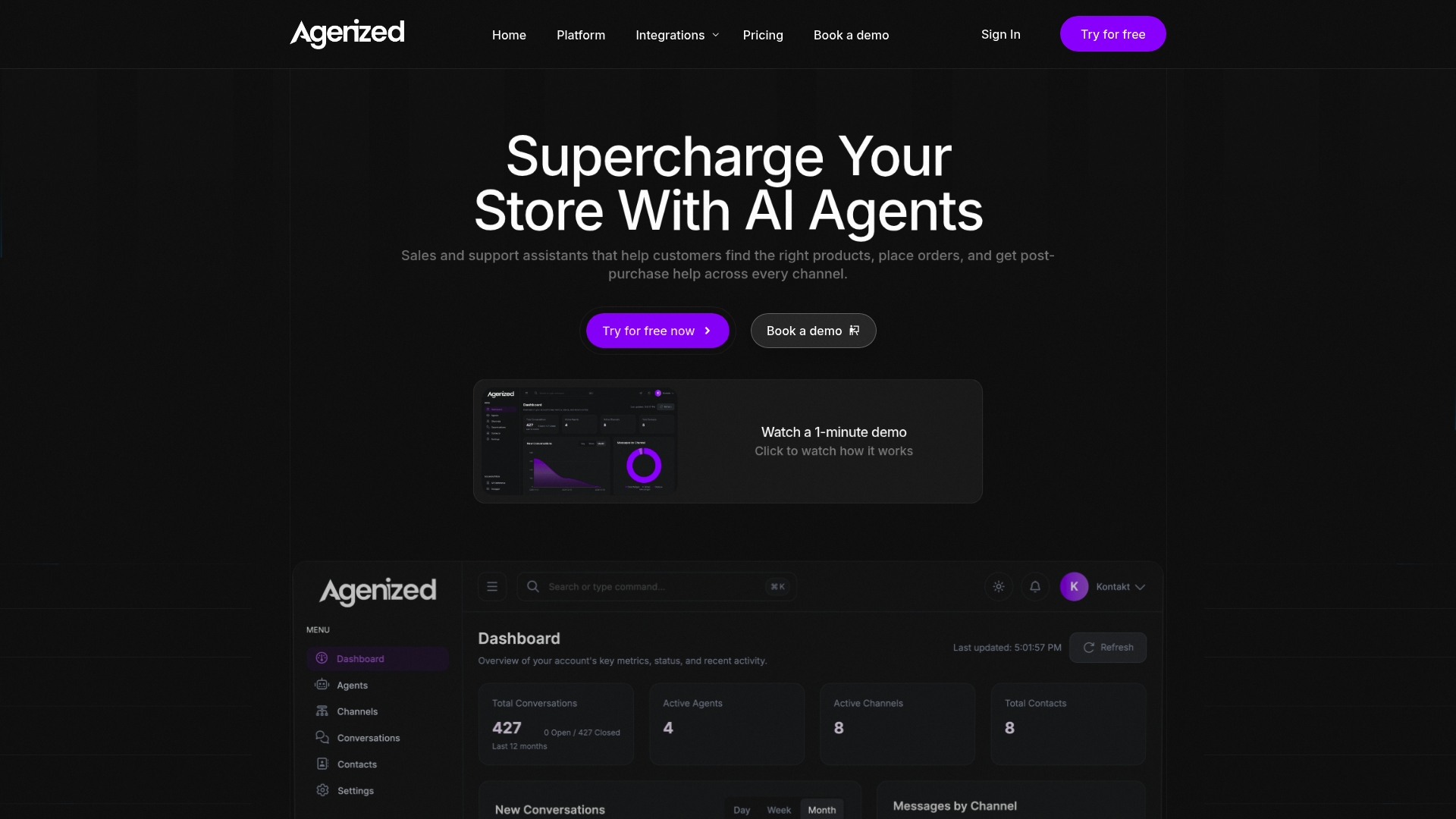
Our solution provides multi-channel AI support across your website, Messenger, WhatsApp, and Instagram, ensuring consistent experiences wherever customers shop. Real-time actions like order retrieval, coupon application, and inventory checks happen directly in conversations, reducing friction and cart abandonment. GDPR-compliant data handling builds trust while delivering personalized recommendations that increase conversions by up to 30%. Whether you operate on Shopify, WooCommerce, or Magento, Agenized integrates seamlessly with visual widget builders and customizable templates. Explore our AI agent workflow guide to see implementation in action, or visit the Agenized homepage to start your free trial today.
Frequently asked questions
What is the role of AI in product discovery for e-commerce?
AI personalizes product suggestions by analyzing customer intent, preferences, and behavior patterns to simplify shopping. These systems support omnichannel deployment and deliver real-time responses across websites and messaging platforms. Effective AI reduces decision fatigue, helping customers find the right products faster while increasing conversion rates and sales.
How do AI chatbots reduce decision fatigue for shoppers?
By using natural language processing and customer data, AI chatbots narrow thousands of products to relevant shortlists based on stated needs and preferences. Personalized recommendations eliminate endless scrolling and overwhelming choices. Shoppers receive curated options with clear comparisons, making selection confident and quick instead of exhausting.
What are common misconceptions about AI chatbots in e-commerce?
Many believe chatbots replace human agents entirely, but they actually complement by handling routine queries and escalating complex issues to people. Not all chatbots perform equally; customization and deep integration determine effectiveness. Privacy regulations like GDPR enhance rather than limit AI use when compliance is built into the design from the start.
How can e-commerce stores implement AI chatbots effectively?
Start by assessing specific product discovery challenges through customer behavior analysis and support ticket reviews. Select customizable platforms with multi-channel support and real-time action capabilities. Train chatbots thoroughly on your product catalog and customer language, ensure GDPR compliance, and monitor performance continuously using conversion rates and satisfaction scores to optimize results over time.