Imagine cutting your customer support costs by 85% while simultaneously improving response times and customer satisfaction. AI agents can autonomously resolve up to 80% of common e-commerce support issues, transforming how online stores handle customer inquiries. E-commerce owners struggle with slow, inconsistent, and expensive support that frustrates customers and drains resources. This guide explains what SaaS AI agents are, how they revolutionize support and sales, and how to integrate them effectively into your store.
Table of Contents
- Understanding SaaS AI Agents In E-Commerce Customer Support
- Why SaaS AI Agents Are Essential For Modern E-Commerce Support
- Key Features Of SaaS AI Agents That Benefit E-Commerce Stores
- Common Misconceptions About SaaS AI Agents
- Business Impact And ROI From SaaS AI Agents
- Integration And Practical Implementation For E-Commerce Stores
- Explore Agenized’s AI Agent Platform For Your E-Commerce Store
- Frequently Asked Questions About SaaS AI Agents In E-Commerce
Key takeaways
| Point | Details |
|---|---|
| SaaS AI agents deliver personalized, scalable, 24/7 support | They reduce costs dramatically while improving customer satisfaction across all channels. |
| Autonomous handling of routine inquiries | AI agents resolve up to 80% of common questions independently, freeing your team for complex issues. |
| Seamless platform integration | Works natively with Shopify, WooCommerce, and Magento while maintaining GDPR compliance. |
| Multilingual communication capabilities | Support reaches 75% of global buyers in their native language, expanding market reach. |
| Real-time sales conversion improvements | Context-aware assistance increases conversions through timely, personalized interactions. |
Understanding SaaS AI agents in e-commerce customer support
SaaS AI agents are advanced, autonomous digital assistants specifically designed for customer support operations. Unlike simple scripted chatbots that follow predetermined decision trees, AI agents leverage natural language understanding, contextual memory, and intelligent decision-making capabilities to deliver genuinely helpful interactions.
These agents remember conversation context throughout entire customer journeys. SaaS AI agents retain conversation context throughout customer interactions, allowing personalized responses that improve customer satisfaction and reduce repeat queries. This contextual awareness means customers never have to repeat themselves or restart conversations.
Robotic process automation handles repetitive backend tasks but lacks conversational intelligence. AI agents combine both capabilities, executing tasks while maintaining natural dialogue. They understand intent, emotion, and nuance in customer messages, responding appropriately rather than robotically.
Key differences between AI agents and traditional chatbots include:
- AI agents learn from interactions and improve over time through machine learning
- They handle ambiguous queries by understanding context rather than requiring exact keyword matches
- Real-time decision-making allows them to take actions like retrieving orders or applying discounts
- Natural language generation creates responses that match your brand voice consistently
- Integration with backend systems enables them to access customer data and execute transactions
For e-commerce specifically, AI agents excel at product discovery by understanding customer preferences and recommending relevant items. They guide shoppers through purchase decisions, answer pre-sale questions, and handle post-purchase support without human intervention.
Why SaaS AI agents are essential for modern e-commerce support
Modern consumers expect immediate responses regardless of time zones or holidays. AI agents provide true 24/7 availability, meeting expectations that traditional support teams cannot match without prohibitive staffing costs.
Scalability represents another critical advantage. A single AI agent simultaneously handles thousands of interactions during peak shopping periods like Black Friday or holiday sales. Your support capacity scales instantly without hiring, training, or managing additional staff.

Personalization drives customer loyalty and repeat purchases. AI agents analyze purchase history, browsing behavior, and previous interactions to deliver relevant recommendations and solutions. This personalized approach increases average order values and customer lifetime value.
AI agents can autonomously resolve up to 80% of common e-commerce support issues, dramatically reducing operational costs. Routine inquiries about order status, return policies, product specifications, and account issues get resolved instantly without human involvement. Your support team focuses exclusively on complex problems requiring human judgment and emotional intelligence.
Speed directly impacts customer satisfaction and conversion rates. Quick first responses and rapid resolutions keep customers engaged rather than abandoning carts or seeking competitors. Detailed AI agent workflows ensure consistent, efficient handling of every inquiry type.
Cost reduction reaches up to 85% when routine support gets automated effectively. This includes savings on salaries, training, infrastructure, and management overhead. The ROI becomes apparent within months for most e-commerce operations.
Key operational benefits include:
- Consistent brand voice across all customer interactions
- Reduced average handling time for every support ticket
- Lower cart abandonment rates through proactive assistance
- Improved first-contact resolution rates
- Better resource allocation for human agents
Key features of SaaS AI agents that benefit e-commerce stores
Multilingual support addresses a critical global commerce challenge. With 75% of online buyers preferring to purchase in their native language, AI agents that communicate fluently in multiple languages expand your addressable market significantly. They detect customer language preferences automatically and respond appropriately.
Natural language processing ensures accurate understanding of customer intent regardless of phrasing or typos. The technology maintains your brand tone consistently, whether conversational, professional, or playful. Every response aligns with your brand guidelines without constant human oversight.
Real-time action capabilities transform AI agents from information providers into transaction facilitators. They retrieve order details, apply coupon codes, update shipping addresses, process returns, and even complete purchases within conversation flows. Customers accomplish their goals without navigating multiple pages or systems.
Escalation workflows recognize when human intervention becomes necessary. Sentiment analysis detects frustration or complex issues requiring empathy and judgment. The AI agent seamlessly transfers conversations to human agents with full context, eliminating customer repetition.
Multi-channel AI support covers every customer touchpoint:
- Facebook Messenger for social commerce interactions
- WhatsApp for personal, conversational support
- Instagram for product discovery and purchase questions
- Gmail for email support with intelligent routing
- Website chat widgets for immediate on-site assistance
- SMS for transactional updates and quick queries
GDPR compliance protects customer privacy and builds trust. Leading SaaS AI platforms implement data protection by design, ensuring personal information handling meets strict European privacy regulations. This compliance extends globally, meeting various regional requirements automatically.
Customization capabilities let you tailor agent personalities, knowledge bases, and response styles to your specific products and customer base. Visual builders enable non-technical teams to configure complex workflows without coding expertise.
Common misconceptions about SaaS AI agents
Many e-commerce owners worry AI agents will replace their support teams entirely. This misconception misunderstands their purpose. AI agents do not replace human agents but augment their productivity by handling repetitive issues and escalating complex ones appropriately.
Human agents remain essential for situations requiring emotional intelligence, creative problem-solving, or handling sensitive customer concerns. AI agents free your team from mundane repetitive tasks, allowing them to focus on high-value interactions that build customer relationships.
Another common myth suggests AI agents deliver only generic, scripted responses. Modern AI agents use context-aware natural language processing to generate unique, relevant answers for each inquiry. They reference specific order details, customer preferences, and conversation history to provide personalized assistance.
Some business owners fear AI interactions feel robotic and damage customer experience. Research shows consumers increasingly prefer AI responses when they maintain brand voice and solve problems efficiently. The key lies in proper implementation and training.
Quality concerns often arise regarding accuracy and reliability. Well-configured AI agents actually improve consistency by eliminating human errors, mood variations, and knowledge gaps. They access your complete knowledge base instantly, providing accurate information every time.
Key points addressing misconceptions:
- AI agents enhance rather than eliminate human support roles
- They provide context-specific responses, not canned scripts
- Proper escalation ensures complex issues reach human experts
- Customer satisfaction often improves with well-designed AI interactions
- Continuous learning improves accuracy and effectiveness over time
Pro Tip: Review successful AI support agent examples from similar stores to understand realistic implementation outcomes and set appropriate expectations for your team.
The technology continues evolving rapidly, with capabilities expanding beyond basic support into sales assistance, personalized marketing, and predictive customer service that anticipates needs before customers articulate them.
Business impact and ROI from SaaS AI agents
Financial impact from AI agent adoption extends far beyond simple cost reduction. Implementing SaaS AI agents can shorten first response times by up to 37% and overall resolution times by up to 50%, dramatically improving customer satisfaction scores and reducing churn.
Support cost reductions reach up to 85% through intelligent automation of routine inquiries. This includes direct savings on staffing, training programs, support infrastructure, and management overhead. Mid-sized e-commerce stores typically see payback periods of three to six months.
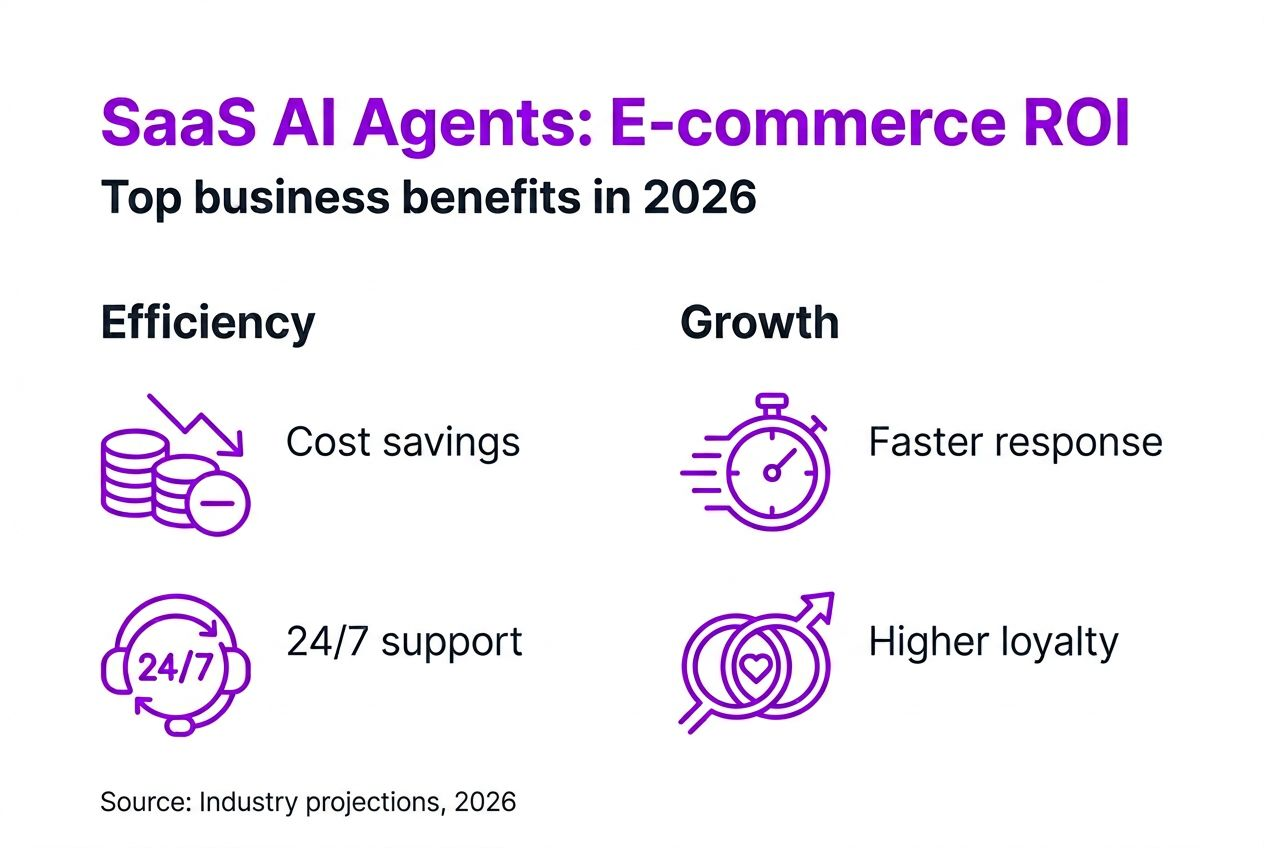
Customer conversions increase measurably when AI agents provide timely, personalized assistance during the purchase journey. Real-time product recommendations, instant answers to pre-purchase questions, and proactive cart abandonment interventions all drive higher conversion rates.
The retail sector specifically stands to gain tremendously. Industry projections estimate a $142 billion potential impact from AI agent adoption by 2026 across global retail operations. Early adopters gain competitive advantages in customer experience and operational efficiency.
| Metric | Traditional Support | With AI Agents | Improvement |
|---|---|---|---|
| First response time | 12 hours | 0 seconds | 100% faster |
| Resolution time | 48 hours | 24 hours | 50% faster |
| Support cost per ticket | $15 | $2 | 85% reduction |
| Customer satisfaction | 72% | 89% | 17 point increase |
| Tickets handled per agent | 25/day | 200/day | 8x capacity |
Customer loyalty improves when support becomes consistently fast and accurate. Repeat purchase rates increase as customers develop confidence in your ability to resolve issues quickly. Positive reviews and word-of-mouth referrals grow naturally from superior support experiences.
Order management workflows become dramatically more efficient when AI agents handle status inquiries, modification requests, and routine issues automatically. Your operations team focuses on exceptions rather than routine processing.
Pro Tip: Continuously monitor key metrics including customer satisfaction scores, ticket resolution rates, and conversion impacts to optimize AI agent settings and maximize your return on investment over time.
Integration and practical implementation for e-commerce stores
Selecting the right SaaS AI platform starts with compatibility verification. Successful platforms integrate smoothly with Shopify, WooCommerce, and Magento, enabling seamless omnichannel support and real-time actions like order checking or applying coupons. Native integrations eliminate custom development and reduce implementation time.
GDPR compliance and privacy protection must be verified before deployment. Ensure your chosen platform implements proper data handling, customer consent management, and right-to-deletion capabilities. This protects your business legally while building customer trust.
Multichannel support should cover all your active customer communication channels. Your AI agent needs presence on social media platforms, email systems, live chat interfaces, and website widgets simultaneously. Unified conversation history across channels prevents customer frustration from repeated explanations.
| Platform Feature | Agenized | Competitor A | Competitor B |
|---|---|---|---|
| Shopify integration | Native | API only | Native |
| Multi-language support | 100+ languages | 50 languages | 75 languages |
| GDPR compliance | Full | Partial | Full |
| Real-time actions | Yes | Limited | Yes |
| Visual workflow builder | Yes | No | Yes |
| Human escalation | Seamless | Manual | Seamless |
Implementation follows a structured six-step process:
- Assess your current support volume, common inquiry types, and channel distribution to establish baseline metrics
- Configure your AI agent knowledge base with product information, policies, and frequently asked questions
- Set up platform integrations with your e-commerce system, CRM, and communication channels
- Design escalation workflows defining when and how complex issues route to human agents
- Pilot the AI agent with a subset of inquiries while monitoring performance and customer feedback closely
- Scale gradually across all channels while training your support team on AI collaboration best practices
Clear escalation criteria ensure quality customer experiences. Define specific triggers like negative sentiment detection, request for human assistance, or inquiry types requiring specialized expertise. The transition should feel seamless to customers.
Staff training focuses on collaboration rather than replacement. Your team learns to handle escalated issues efficiently, review AI interactions for quality, and update knowledge bases based on emerging customer needs. This partnership maximizes both AI and human capabilities.
Continuous optimization improves AI agent performance over time. Regular review of conversation logs, customer feedback, and resolution rates identifies improvement opportunities. Update responses, refine workflows, and expand knowledge bases based on real usage patterns.
Explore Agenized’s AI agent platform for your e-commerce store
Transforming your customer support starts with the right platform. Agenized offers specialized SaaS AI agents designed specifically for e-commerce operations, with multi-channel support, real-time transaction capabilities, and full GDPR compliance built in from the ground up.
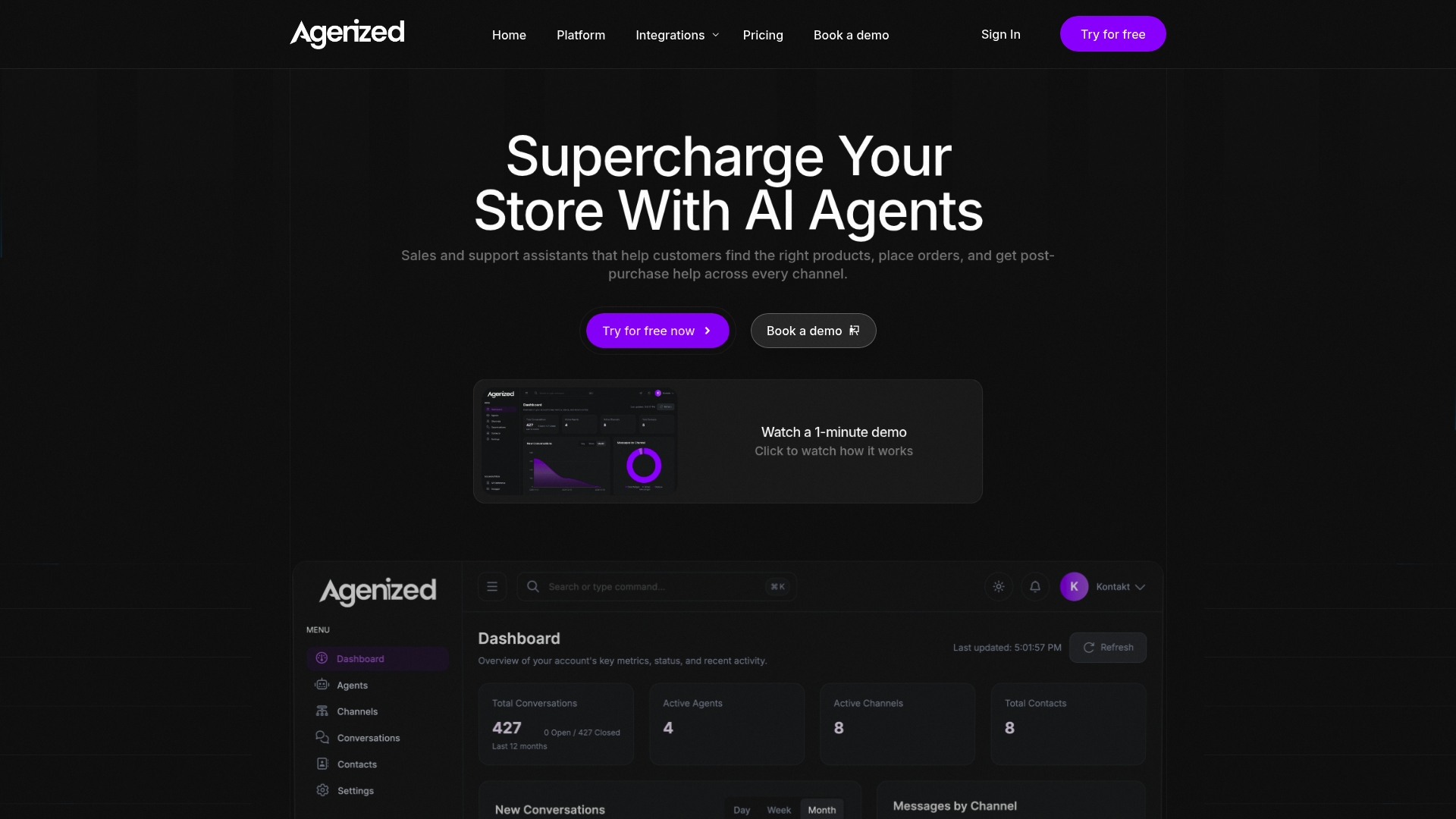
The platform simplifies complex AI deployment through no-code visual builders and pre-configured workflows optimized for common e-commerce scenarios. You customize agent personalities, responses, and actions without technical expertise or expensive development resources.
Explore detailed resources including comprehensive workflow guides and extensive integration documentation on the Agenized site. These resources provide practical implementation guidance specific to your platform and business model.
Adopting Agenized lets your store deliver faster, more personalized support that builds customer loyalty and drives sales growth. The platform scales with your business, from initial deployment through rapid growth phases.
Frequently asked questions about SaaS AI agents in e-commerce
What is the main difference between SaaS AI agents and chatbots?
SaaS AI agents use contextual understanding and perform real-time tasks autonomously, while traditional chatbots follow scripted response trees. AI agents provide personalized, intelligent conversations rather than answering only preset frequently asked questions.
Can SaaS AI agents handle multiple languages and comply with GDPR?
Yes, leading SaaS AI agents offer robust multilingual support covering over 75% of customer languages worldwide. They also fully comply with GDPR and other privacy regulations, protecting customer data and building trust through proper consent management.
Do AI agents completely replace human customer support?
No, AI agents automate routine inquiries and escalate complex cases requiring human judgment to your support team. They augment rather than replace human staff, boosting team productivity by handling repetitive tasks efficiently.
How do SaaS AI agents integrate with popular e-commerce platforms?
They offer seamless native integration with Shopify, WooCommerce, and Magento, enabling omnichannel support and real-time order management. Integration typically requires minimal technical setup and supports multi-channel communication across social media, email, and website chat.
What measurable ROI can I expect from implementing SaaS AI agents?
Expect up to 85% reduction in support costs, 37% faster first response times, and 50% faster overall resolution times. Personalized AI interactions also increase customer conversions, improve satisfaction scores, and boost repeat purchase rates measurably.