Retailers using advanced demand sensing in 2026 report a 40% reduction in inventory carrying costs and a 20% increase in net margin. These numbers reveal that streamlining customer experience goes far beyond improving website aesthetics or simplifying checkout buttons. For ecommerce managers and digital marketing professionals, streamlining now means deploying AI to anticipate customer needs, optimize pricing windows, and deliver consistent support across every channel. This guide explains how AI-driven strategies transform customer journeys into measurable business gains.
Table of Contents
- What Does Streamlining Customer Experience Mean In Ecommerce?
- How Ai-Driven Demand Sensing And Margin Optimization Boost Customer Experience
- Multi-Channel Ai Support And Personalization For Enhanced Engagement
- Implementing Streamlined Ai Customer Experience Workflows: Practical Considerations
- Explore Agenized’s Ai Platform To Streamline Your Ecommerce Experience
Key takeaways
| Point | Details |
|---|---|
| Streamlining boosts satisfaction and revenue | Eliminating friction points and automating personalized interactions directly increase engagement and sales. |
| AI enables demand sensing and margin optimization | Anticipating market needs and identifying optimal pricing windows improve profitability without losing conversions. |
| Multi-channel AI support enhances responsiveness | Consistent assistance across Messenger, WhatsApp, Instagram, and website chat increases customer loyalty. |
| Implementing AI workflows improves efficiency | Structured rollout phases and targeted pilots reduce costs while scaling performance. |
| Tools and best practices exist for 2026 | Proven frameworks and platforms help ecommerce teams deploy AI successfully. |
What does streamlining customer experience mean in ecommerce?
Streamlining customer experience in ecommerce involves eliminating friction points, automating personalized interactions, and integrating channels so customers move seamlessly from discovery to purchase and post-sale support. It’s not just about faster page loads or cleaner navigation. Ecommerce AI in 2026 enables demand sensing to anticipate market needs, moving beyond reactive inventory management. This predictive capability allows you to stock the right products at the right time, reducing waste and meeting customer expectations before they even articulate them.
AI plays a pivotal role by analyzing customer behavior patterns, purchase history, and browsing data to personalize product recommendations and support responses. When you integrate AI chatbots into your store, you enable real-time assistance that adapts to individual customer needs. This level of responsiveness transforms inventory and pricing strategies because AI identifies when customers are most likely to convert and which products will experience surges in demand.
Key components of streamlined ecommerce customer experience include:
- Seamless navigation across devices and channels
- AI chatbots providing instant, accurate product information
- Proactive support that resolves issues before customers need to ask
- Personalized product discovery based on browsing and purchase history
- Unified customer data across all touchpoints
These elements work together to create a cohesive journey. When customers receive consistent, intelligent support whether they message you on Instagram or visit your website directly, they trust your brand more and complete purchases faster. Streamlining isn’t a single upgrade. It’s an ongoing commitment to removing obstacles and delivering value at every interaction point.
How AI-driven demand sensing and margin optimization boost customer experience
Demand sensing uses machine learning algorithms to analyze historical sales data, seasonal trends, competitor pricing, and external signals like social media sentiment to predict what customers will want before they search for it. This predictive accuracy directly impacts customer experience because shoppers find products in stock when they need them. Nothing frustrates customers more than discovering their desired item is unavailable. Retailers using advanced demand sensing in 2026 report a 40% reduction in inventory carrying costs and a 20% increase in net margin, proving that accurate predictions benefit both your bottom line and customer satisfaction.

Margin windows represent brief periods when AI detects that raising prices by a specific percentage won’t reduce conversion rates. These windows occur when demand spikes, competitor stock runs low, or customer urgency increases. By identifying these moments, you can capture additional revenue without alienating buyers. AI identifies margin windows to increase prices without impacting conversion, allowing you to balance profitability with customer trust.
| AI Strategy | Inventory Cost Savings | Margin Improvement | Customer Satisfaction Impact |
|---|---|---|---|
| Demand sensing | 40% reduction | 15% increase | Higher product availability |
| Margin window optimization | 10% reduction | 20% increase | Minimal friction with dynamic pricing |
| Combined approach | 50% reduction | 35% increase | Seamless experience with optimal pricing |
Implementing AI-driven demand sensing and margin optimization together transforms your ecommerce operation from reactive to anticipatory, delivering the right products at the right prices while maintaining exceptional customer engagement and loyalty.
When you combine these strategies, you create a virtuous cycle. Better inventory management means fewer stockouts and overstock situations. Optimized pricing maximizes revenue without driving customers away. Customers experience a store that consistently meets their needs, which builds loyalty and encourages repeat purchases. The ecommerce AI blueprint shows how leading retailers integrate these technologies to stay competitive in 2026.
Multi-channel AI support and personalization for enhanced engagement
Deploying multi-channel AI support requires a structured approach to ensure consistency and effectiveness across platforms. Follow these sequential steps to implement AI customer support successfully:
- Audit your current customer touchpoints to identify where customers seek help most frequently.
- Select an AI platform that integrates with your existing ecommerce stack and supports Messenger, WhatsApp, Instagram, Gmail, and website chat.
- Train your AI agents using historical customer conversations, product data, and common support queries.
- Launch a pilot program on your highest-traffic channel to test AI responses and gather feedback.
- Expand gradually to additional channels, refining AI training based on real customer interactions.
- Monitor performance metrics like response time, resolution rate, and customer satisfaction scores.
- Iterate continuously by feeding new product information and customer feedback into your AI training data.
Personalized product discovery integrated with AI support agents creates a seamless experience where customers receive recommendations tailored to their browsing history, purchase patterns, and stated preferences. When a customer asks your AI chatbot for gift ideas, the agent analyzes past purchases and suggests relevant products without requiring the customer to repeat information. This level of personalization increases conversion rates because customers feel understood and valued.
Pro Tip: Avoid common personalization pitfalls by continuously tuning your AI models with fresh customer data and actively soliciting feedback after each interaction. Over-personalization can feel intrusive, so balance recommendations with customer privacy preferences and allow easy opt-outs.
Well-timed margin adjustments complement personalized offers by ensuring you present optimal prices when customers are most likely to convert. AI identifies margin windows to increase prices without impacting conversion, meaning your personalized product suggestions can include dynamic pricing that maximizes revenue while maintaining customer trust. When customers receive relevant recommendations at competitive prices, they complete purchases faster and return more often. Following AI chatbot best practices ensures your multi-channel support remains effective and customer-focused.
Implementing streamlined AI customer experience workflows: practical considerations
Successful AI implementation follows structured phases that reduce risk and allow you to measure results at each stage. Begin with an assessment phase where you evaluate current customer pain points, support ticket volumes, and conversion funnel drop-off rates. This baseline data helps you identify where AI can deliver the most immediate impact. Next, launch a pilot program targeting one specific use case, such as automating product recommendation questions or handling order status inquiries. Pilots provide controlled environments to test AI performance without risking your entire customer base.
After validating pilot results, proceed to rollout by expanding AI features across additional channels and use cases. During rollout, maintain close monitoring of key metrics like resolution time, escalation rates to human agents, and customer satisfaction scores. The final phase involves ongoing measurement and optimization where you continuously refine AI training data based on new customer interactions and product catalog updates. Retailers using advanced demand sensing in 2026 report significant cost reductions and margin improvements by following these structured implementation phases.
Integrating AI with your existing ecommerce platform is critical for seamless operation. Ensure your chosen AI solution connects natively with Shopify, WooCommerce, Magento, or your preferred platform. Native integrations enable real-time access to order data, inventory levels, and customer profiles, allowing your AI agents to execute actions like retrieving order status, applying discount codes, or updating shipping addresses without requiring manual intervention.
Common challenges and solutions include:
- Data quality issues: Clean and standardize customer data before training AI models to ensure accurate responses.
- Employee training gaps: Provide comprehensive onboarding so your team understands how to manage and optimize AI agents.
- Ongoing optimization needs: Schedule regular reviews of AI performance and update training data with new products and customer feedback.
- Integration complexity: Choose platforms with pre-built connectors and robust API documentation to simplify technical setup.
- Customer adoption resistance: Communicate clearly about AI capabilities and always offer easy escalation to human agents.
Pro Tip: Start small by deploying AI for one high-impact use case like automating FAQ responses or product recommendations. Track performance metrics rigorously for 30 days, then scale based on data showing improved customer satisfaction and reduced support costs. This incremental approach minimizes risk and builds internal confidence in AI capabilities. Leverage an AI agent workflow guide to structure your implementation effectively and avoid common pitfalls.
Explore Agenized’s AI platform to streamline your ecommerce experience
Agenized provides AI-powered sales and support agents designed specifically for ecommerce stores seeking to streamline customer experiences across multiple channels. The Agenized platform enables you to deploy customizable AI chatbots on your website, Messenger, WhatsApp, Instagram, and Gmail with minimal technical setup. These agents assist customers in product discovery, execute real-time actions like retrieving orders and applying coupons, and escalate complex issues to human agents when necessary.
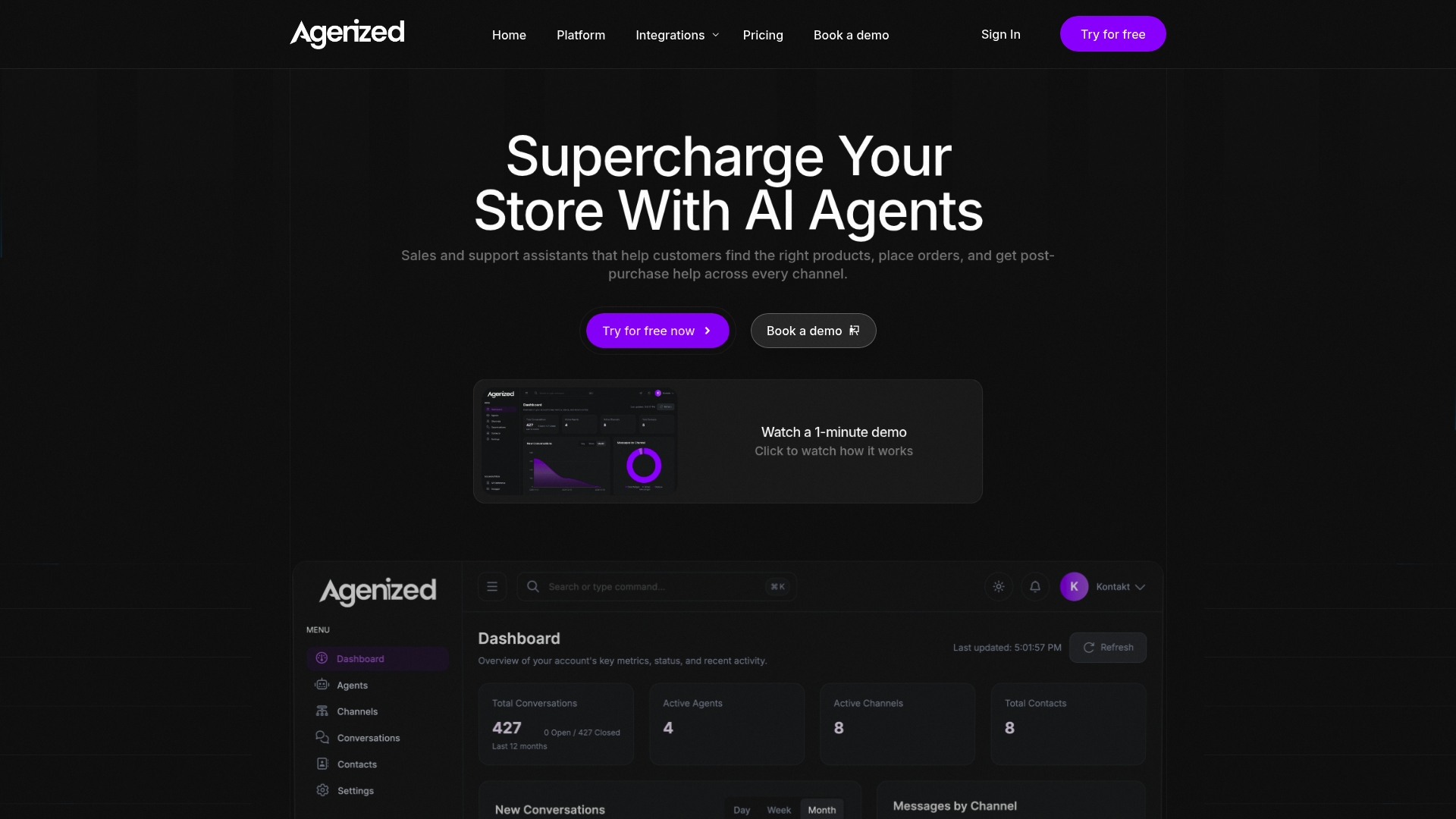
If you’re ready to implement the AI-driven strategies discussed in this guide, explore Agenized’s step-by-step AI agent workflow to structure your deployment effectively. The platform’s visual widget builder and pre-built templates for sales and support make integration with Shopify, WooCommerce, and Magento straightforward. Agenized’s multi-channel AI support solutions ensure consistent customer experiences whether shoppers reach you on social media or your website, delivering measurable improvements in engagement, conversion rates, and operational efficiency.
FAQ
What is the biggest impact of streamlining customer experience with AI?
The biggest impact is improved sales and customer loyalty through reduced friction at every touchpoint. When customers receive instant, accurate support and personalized product recommendations, they complete purchases faster and return more frequently. AI-driven streamlining also reduces operational costs by automating repetitive support tasks, freeing your team to handle complex issues that require human judgment. Customer engagement AI delivers measurable revenue increases while improving satisfaction scores.
How does demand sensing improve inventory management?
Demand sensing uses AI to analyze purchasing patterns, seasonal trends, and external signals to predict what customers will buy before they search for it. This predictive capability allows you to stock optimal inventory levels, reducing waste from overstock and lost sales from stockouts. Retailers using advanced demand sensing in 2026 report a 40% reduction in inventory carrying costs, translating directly to improved cash flow and customer satisfaction.
What are margin windows and how do they affect pricing?
Margin windows are brief periods when AI detects you can raise prices without reducing conversion rates. These windows occur during demand spikes, low competitor stock, or high customer urgency. AI identifies periods where prices can be increased by 15% without impacting conversion, allowing you to capture additional revenue while maintaining customer trust. Proper margin window optimization balances profitability with long-term customer relationships.
How can I start implementing AI to streamline my customer experience?
Start by piloting one high-impact AI feature like chatbots for FAQ automation or demand sensing for inventory optimization. Choose a platform that integrates seamlessly with your ecommerce stack and track performance metrics for 30 days before expanding. Use an AI implementation guide to structure your rollout phases and avoid common pitfalls like poor data quality or insufficient employee training.