AI-powered chatbots can reduce customer response times by 30% while boosting e-commerce sales by 20%. For online retailers juggling customer inquiries across multiple channels, this technology transforms how support teams operate. This guide explains what AI-powered support is, how it works across platforms like Messenger and WhatsApp, and the practical steps to implement it effectively in your store.
Table of Contents
- What Is AI-Powered Support? Definition And Core Concepts
- How AI-Powered Support Works Across Channels
- Benefits Of AI-Powered Support In E-Commerce
- Common Misconceptions About AI-Powered Support
- Key Features Of AI-Powered E-Commerce Support Agents
- Framework For Assessing AI-Powered Support Solutions
- Implementing AI-Powered Support: Tools And Best Practices
- Regulatory And Privacy Considerations In AI Support
- Real-World Impact And Case Studies
- Explore AI-Powered Support Solutions With Agenized
- Frequently Asked Questions
Key takeaways
| Point | Details |
|---|---|
| AI automates 24/7 customer interactions | Natural language processing and machine learning enable continuous personalized assistance without human oversight. |
| Multi-channel integration boosts engagement | AI chatbots operate seamlessly across Messenger, WhatsApp, Instagram, Gmail, and website widgets. |
| Measurable business benefits | Expect faster response times, higher sales conversions, reduced manual workload, and improved customer satisfaction scores. |
| AI complements human agents | Chatbots handle routine queries while complex issues escalate to human support teams. |
| Implementation requires planning | Success depends on customization, compliance with data privacy regulations, and clear escalation protocols. |
What is AI-powered support? Definition and core concepts
AI-powered support uses natural language processing and machine learning to automate customer interactions, enabling 24/7 personalized assistance in e-commerce. At its core, this technology mimics human conversation patterns, allowing chatbots to understand customer questions and deliver relevant answers without human intervention.
Natural language processing (NLP) is the engine that decodes customer messages. When someone types “Where’s my order?” the NLP system identifies intent, extracts key information like order numbers, and formulates an appropriate response. This happens instantly, eliminating wait times that frustrate customers.
Machine learning takes AI support beyond simple scripts. Every customer interaction trains the system, improving accuracy over time. If customers frequently ask about return policies in specific ways, the AI adapts its recognition patterns to catch those variations. This continuous learning means your chatbot gets smarter with each conversation.
Key capabilities of AI-powered support include:
- Instant responses to common questions about shipping, returns, and product specifications
- Personalized product recommendations based on browsing history and purchase patterns
- Real-time order status updates without requiring human lookup
- Automated ticket creation and routing for complex issues
- Multilingual support enabling global customer service
The technology operates continuously, handling midnight inquiries with the same efficiency as daytime questions. For e-commerce stores, this means capturing sales opportunities when human teams are offline. A customer browsing at 2 AM gets immediate help finding the right product size, preventing cart abandonment.

How AI-powered support works across channels
Modern customers expect to reach brands wherever they spend time online. Multi-channel AI support in e-commerce delivers consistent assistance across Messenger, WhatsApp, Instagram, Gmail, and website chat widgets. This omnipresence meets customers where they already are, rather than forcing them to visit specific platforms.
Integration mechanics vary by channel but share common principles. For Facebook Messenger, the AI connects through the Messenger API, detecting incoming messages and responding in real time. WhatsApp integration works similarly, using WhatsApp Business API to handle customer conversations. Instagram Direct Messages follow the same pattern, letting customers ask questions without leaving the app.
Website chat widgets embed directly into your store pages. When visitors click the chat icon, they interact with the same AI brain powering your other channels. This creates a unified knowledge base, so the chatbot provides identical answers whether customers reach out via Instagram or your homepage.
Seamless handoffs prevent frustrating repetition. If a customer starts a conversation on WhatsApp asking about product availability, then continues via website chat, the AI recognizes the same user and maintains conversation context. No need to re-explain the situation.
Research shows multi-channel chatbot presence increases engagement by 35% compared to single-channel support. Customers appreciate the flexibility to switch platforms mid-conversation without losing progress.
Benefits of multi-channel AI deployment:
- Higher customer reach by meeting users on preferred platforms
- Consistent brand voice across all communication channels
- Reduced customer effort through context-aware conversations
- Greater sales opportunities from expanded touchpoints
- Unified analytics tracking performance across channels
Pro Tip: Start with two to three channels where your customers are most active, then expand gradually to avoid overwhelming your setup process.
Benefits of AI-powered support in e-commerce
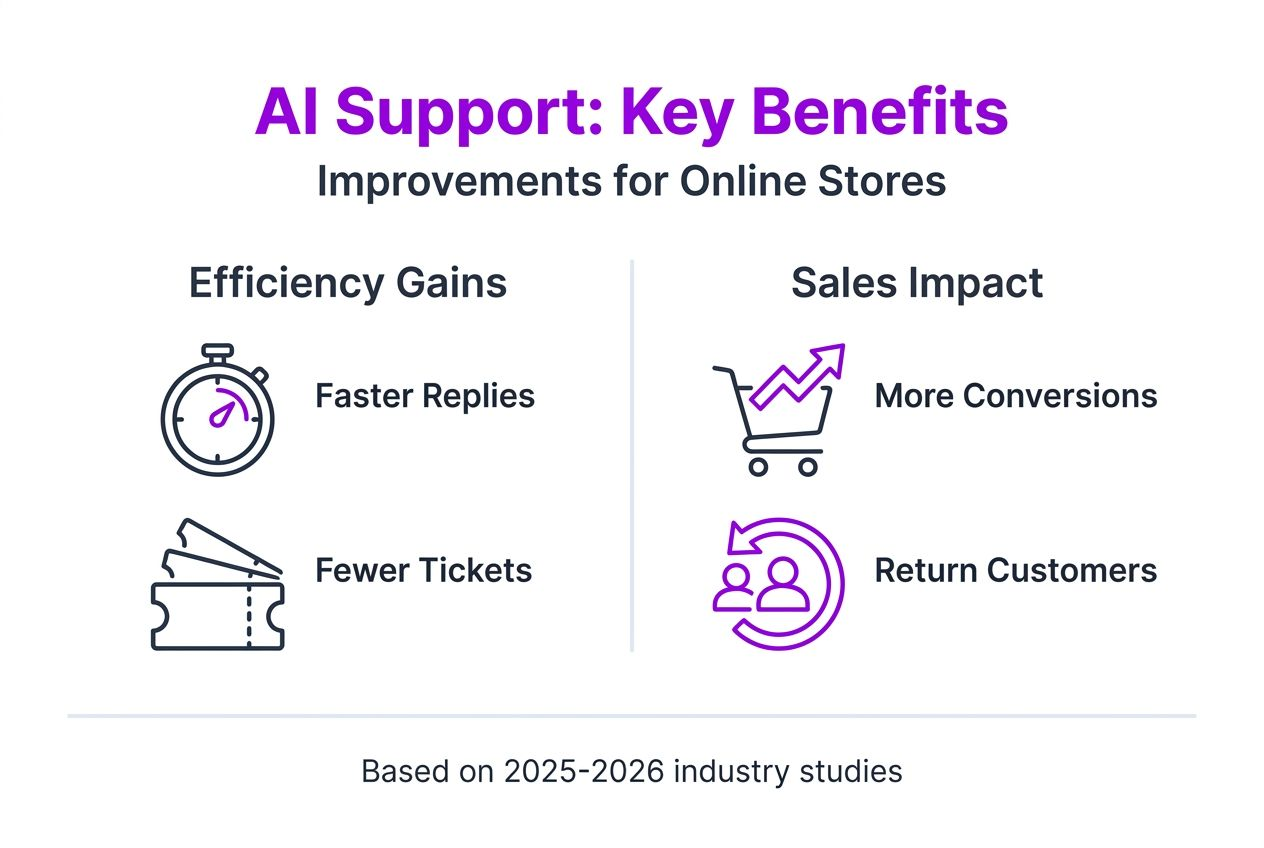
AI-powered support improves response time by 30%, increases sales conversions by 20%, decreases manual tasks by 40%, and raises customer satisfaction by 15%. These metrics represent real business impact that directly affects your bottom line and operational efficiency.
| Metric | Before AI | After AI | Improvement |
|---|---|---|---|
| Average response time | 8 minutes | 5.6 minutes | 30% faster |
| Sales conversion rate | 2.5% | 3.0% | 20% increase |
| Manual support tasks | 100 tickets/day | 60 tickets/day | 40% reduction |
| Customer satisfaction | 78% | 89.7% | 15% improvement |
Real-time action execution accelerates order handling significantly. When customers ask about order status, AI chatbots instantly retrieve tracking information from your database and display it in the conversation. No waiting for a human agent to look it up. Coupon application works the same way, with the AI applying discount codes during checkout conversations.
Operational efficiencies multiply as AI handles repetitive questions. Your human team stops answering “What’s your return policy?” fifty times daily and focuses on complex issues requiring judgment. This shift reduces burnout and improves job satisfaction among support staff.
Boosting sales with AI chatbots happens through personalized engagement. The AI analyzes browsing behavior and suggests relevant products mid-conversation. A customer asking about running shoes might receive recommendations for matching athletic wear, increasing average order value.
Customer engagement improves because AI remembers past purchases and preferences. Returning customers get personalized greetings and product suggestions based on their history, creating a VIP experience at scale.
Pro Tip: Monitor KPIs like response time, conversion rate, and customer satisfaction weekly after deployment to quantify AI impact and identify optimization opportunities.
Common misconceptions about AI-powered support
Many businesses hesitate to adopt AI chatbots due to misunderstandings about their capabilities and limitations. The biggest myth is that AI completely replaces human support teams. In reality, 70% of queries are routine while 30% require human interaction, making AI a complement rather than a replacement.
Routine queries include order tracking, return policy questions, product specifications, shipping costs, and store hours. These follow predictable patterns that AI handles efficiently. Complex issues like damaged products requiring photographic evidence, custom order modifications, or escalated complaints need human judgment and empathy.
The typical query split works like this:
- Simple FAQs (40%): Automated completely by AI
- Moderate complexity (30%): AI provides initial response, human reviews if needed
- Complex issues (30%): Immediate escalation to human agents
Human oversight remains essential for quality control and handling edge cases. Your support team monitors AI conversations, stepping in when the chatbot reaches its limits. This partnership maximizes efficiency while maintaining service quality.
Another misconception is that AI chatbots solve all problems instantly. While response times improve dramatically, AI cannot fix backend issues like inventory shortages or shipping delays. It can only communicate existing information and execute programmed actions.
Realistic expectations prevent disappointment. AI excels at information retrieval, basic troubleshooting, and transactional tasks. It struggles with nuanced emotional situations, creative problem-solving, and scenarios requiring policy exceptions. Set clear boundaries for what your AI handles versus what requires human escalation.
Some retailers fear customers dislike chatbots. Research shows customers appreciate fast, accurate answers regardless of source. The key is transparency. Let users know they’re chatting with AI and offer easy escalation to humans when needed.
Key features of AI-powered e-commerce support agents
AI support should include order retrieval automation, customizable templates, multi-language support, GDPR compliance, and seamless human escalation. These features separate basic chatbots from sophisticated support agents that deliver real business value.
Real-time action execution transforms passive information delivery into active problem-solving. When customers ask about order status, the AI queries your order management system, retrieves current shipping information, and displays it conversationally. Coupon applications work similarly, with the chatbot applying discount codes directly during checkout flows.
Customizable agent templates let you tailor chatbot personality and responses to match your brand voice. Support agent features include pre-built conversation flows for common scenarios like product inquiries, order tracking, and returns processing. You modify these templates with your specific policies and product details.
User-friendly widget builders eliminate coding requirements. Visual editors let you design chat interfaces, choose colors matching your brand, and position widgets on specific pages. Deploy chatbots across your entire store or limit them to high-traffic product pages.
Multi-language support is vital for global e-commerce. Advanced AI detects customer language automatically and responds accordingly. A Spanish-speaking customer gets Spanish responses without manual language selection, creating friction-free experiences.
GDPR compliance features protect both your business and customers. Look for platforms offering:
- Transparent data collection notices
- Customer consent management
- Secure data encryption and storage
- Easy data deletion upon request
- Audit logs tracking data access
Seamless escalation to human agents prevents customer frustration when AI reaches complexity limits. The chatbot recognizes when it cannot help, summarizes the conversation context, and transfers to an available human agent. The customer never repeats information.
Pro Tip: Choose AI tools with built-in compliance features to avoid legal risks and maintain customer trust without extensive legal review.
Framework for assessing AI-powered support solutions
Evaluating AI support platforms requires structured comparison across five critical pillars: multi-channel integration, real-time action execution, customization ease, human escalation, and data privacy compliance. This framework helps you compare options systematically and choose solutions matching your business needs.
| Evaluation Pillar | Basic Chatbots | Advanced AI Support Agents | Business Impact |
|---|---|---|---|
| Multi-channel integration | Single channel (website only) | Messenger, WhatsApp, Instagram, Gmail, website | Higher customer reach and engagement |
| Real-time action execution | Static responses only | Order lookup, coupon application, inventory checks | Faster resolution, increased sales |
| Customization ease | Code-required changes | Visual builders, templates | Reduced setup time, brand consistency |
| Human escalation | Manual transfer required | Automatic context-aware handoff | Better customer experience |
| Data privacy compliance | Basic security | GDPR-compliant, encrypted, audit logs | Legal protection, customer trust |
Follow this numbered assessment process:
- List your top three customer service channels where inquiries arrive most frequently.
- Identify which actions your chatbot must execute in real time (order status, returns, coupons).
- Evaluate how much customization your team can handle based on technical skills.
- Define clear escalation triggers when human intervention becomes necessary.
- Verify platform compliance with data privacy regulations applicable to your markets.
Each pillar impacts customer experience and operational efficiency differently. Multi-channel integration expands your support footprint, meeting customers on preferred platforms. Real-time actions reduce resolution time from minutes to seconds. Easy customization speeds deployment and maintains brand voice consistency.
Human escalation quality determines whether complex issues get resolved or escalate into complaints. Data privacy compliance protects your business from regulatory fines and maintains customer trust in an era of heightened privacy awareness.
Tailor your selections to business size and customer volume. Small stores handling 100 monthly conversations need different features than mid-sized retailers managing thousands. Start with essential features and expand as needs grow.
Implementing AI-powered support: tools and best practices
Small to mid-sized stores achieved efficiency gains of 35% after AI support deployment. Success requires following a structured implementation sequence that balances technical setup with team preparation.
Follow this five-step deployment sequence:
- Assess needs: Analyze your current support volume, common question types, and channel distribution. Identify which 70% of queries are routine enough for AI automation.
- Select tools: Compare platforms using the evaluation framework above. Prioritize solutions integrating with your existing e-commerce platform (Shopify, WooCommerce, Magento).
- Customize: Configure chatbot personality, conversation flows, and response templates. AI agent workflow steps guide you through setup systematically.
- Deploy and monitor: Launch on your primary channel first, track performance metrics daily, and adjust based on customer feedback.
- Train staff: Prepare your support team for escalation handling and teach them to monitor AI conversations for quality control.
Branding your chatbot voice maintains consistency across customer touchpoints. If your brand uses casual, friendly language, program the AI to match that tone. Formal brands require professional phrasing. Script variations for different customer journey stages, from browsing to post-purchase support.
Continuous performance tracking against KPIs prevents degradation over time. Monitor response accuracy, resolution rates, and customer satisfaction scores weekly. Multi-channel AI support implementation requires channel-specific tracking to identify which platforms perform best.
Customer engagement AI techniques include proactive outreach based on browsing behavior. Configure your AI to initiate conversations when customers spend over 60 seconds on product pages, offering assistance before they ask.
Train customer service teams on escalation protocols and fallback processes. They need clear guidelines on when to override AI responses and how to access conversation history when taking over from chatbots.
Common implementation pitfalls to avoid:
- Expecting AI to handle 100% of queries without human backup
- Ignoring data privacy compliance during initial setup
- Deploying across all channels simultaneously without testing
- Failing to update AI knowledge base as policies change
- Neglecting performance monitoring after initial launch
Regulatory and privacy considerations in AI support
GDPR compliance requires transparent personal data handling, customer consent, and secure storage; violations can incur fines up to €20 million or 4% of global turnover. For e-commerce businesses using AI chatbots, understanding these requirements is non-negotiable.
GDPR essentials for e-commerce AI support include:
- Data transparency: Clearly inform customers what data the chatbot collects and how you use it. Display privacy notices before conversations begin.
- Lawful basis for processing: Establish legitimate reasons for collecting customer data, typically consent for marketing or contractual necessity for order processing.
- Customer consent: Obtain explicit opt-in for data collection, with easy opt-out mechanisms available anytime.
- Data security: Encrypt all customer conversations and store data on secure servers with access controls.
- User rights: Enable customers to request their data, correct inaccuracies, or demand deletion upon request.
Risks of non-compliance extend beyond financial penalties. Reputation damage from data breaches or privacy violations can destroy customer trust permanently. News of improper data handling spreads quickly on social media, potentially costing you customers who never return.
Data security requirements mean encrypting all chatbot conversations both in transit and at rest. Use platforms offering end-to-end encryption and regular security audits. Limit employee access to customer data based on role requirements.
Inform customers clearly about AI usage. Display notices stating “You’re chatting with an AI assistant” at conversation start. Explain that conversations may be reviewed for quality improvement and offer easy escalation to human agents.
Adopting GDPR-compliant platforms simplifies ongoing compliance. Look for solutions with built-in consent management, automated data deletion workflows, and compliance certifications from recognized auditing bodies. This protects your business while building customer confidence in your AI solutions.
Real-world impact and case studies
Small and mid-sized stores reported 27% increase in customer retention, 22% growth in average order value, and significant efficiency gains after AI support implementation. These concrete results demonstrate the tangible business value AI-powered chatbots deliver.
| Metric | Before AI Implementation | After AI Implementation | Change |
|---|---|---|---|
| Customer retention rate | 68% | 86.4% | +27% |
| Average order value | $85 | $103.70 | +22% |
| Support tickets resolved daily | 150 | 210 | +40% |
| First response time | 12 minutes | 30 seconds | 96% faster |
AI automating product discovery drives the average order value increase. When customers ask about specific items, chatbots suggest complementary products based on purchase history and browsing patterns. AI product discovery impact shows recommendation engines increase basket size by presenting relevant add-ons during conversations.
Automation reduces support tickets by handling routine questions without human involvement. Order tracking inquiries drop from agent queues entirely as the AI retrieves shipping information instantly. Password resets, return policy questions, and store hours all get automated responses.
Order processing speeds up when AI handles initial intake and information gathering. A customer initiating a return provides reason codes and product details to the chatbot, which creates a pre-filled return ticket for human review. This cuts processing time from 15 minutes to 5 minutes per return.
Benefits reported across various store sizes and sectors include:
- Fashion retailers: 30% reduction in size and fit questions through AI-powered sizing recommendations
- Electronics stores: 45% faster technical support resolution with automated troubleshooting flows
- Beauty brands: 25% increase in subscription sign-ups from proactive chatbot engagement
- Home goods retailers: 35% decrease in cart abandonment through real-time shopping assistance
Support agent success examples across industries demonstrate versatility. Whether you sell physical products or digital goods, AI chatbots adapt to your specific support needs and customer questions.
SaaS AI agents for e-commerce offer faster deployment compared to custom-built solutions. Cloud-based platforms require no hardware investment and scale automatically during traffic spikes like Black Friday.
Proven impacts build confidence to adopt AI-powered support. Starting with pilot programs on limited channels lets you validate results before full deployment. Track metrics closely during initial weeks to demonstrate ROI to stakeholders.
Explore AI-powered support solutions with Agenized
Agenized offers an easy-to-integrate AI chatbot platform designed specifically for e-commerce stores seeking to automate customer support while boosting sales. The platform delivers multi-channel support across Messenger, WhatsApp, Instagram, and website widgets, enabling you to meet customers wherever they prefer to communicate.
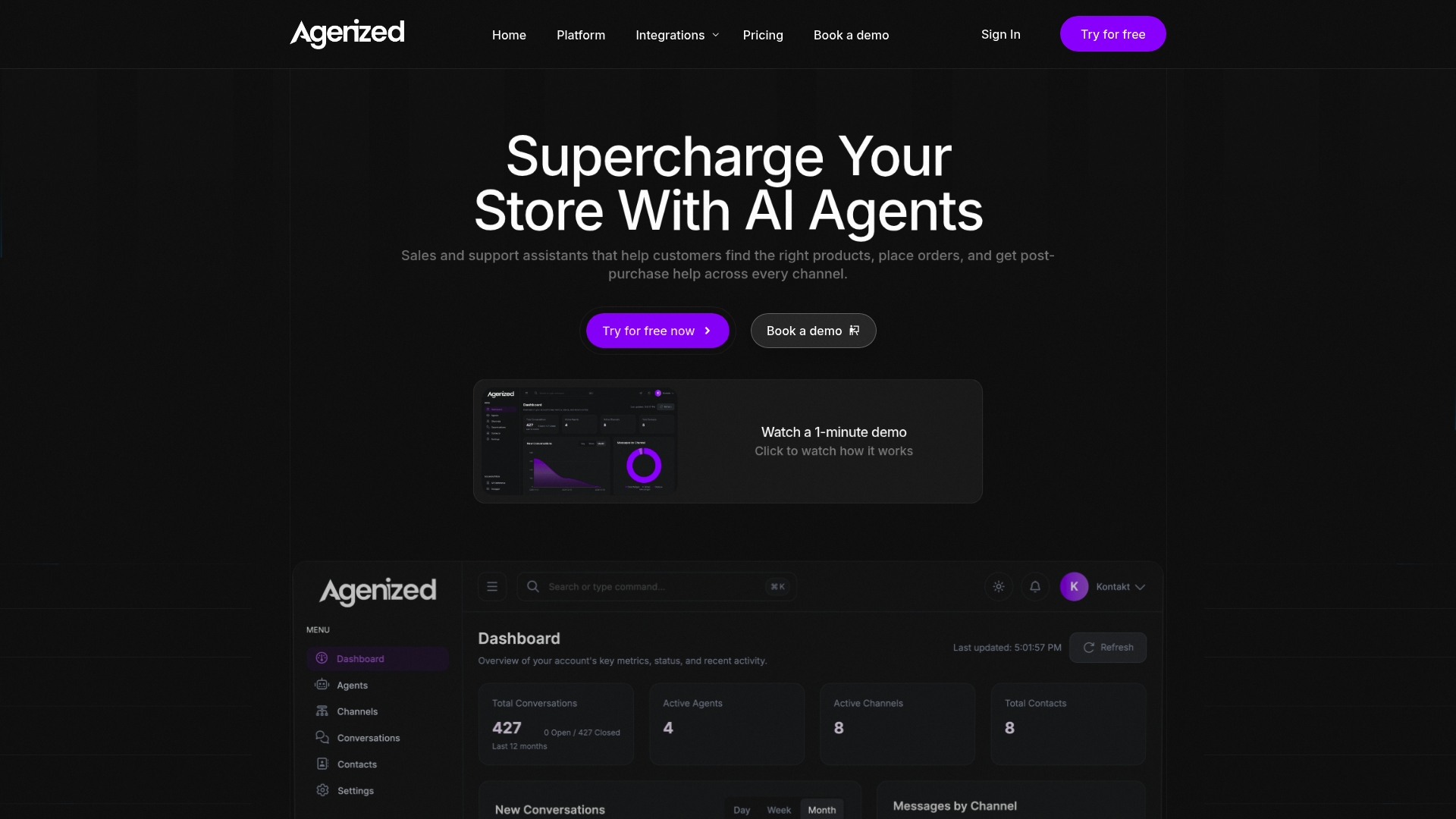
Key features include real-time order retrieval, automated coupon application, and GDPR-compliant data handling that protects both your business and customers. Customizable agent templates let you deploy support chatbots in hours, not weeks, using visual builders that require zero coding knowledge.
Explore the step-by-step AI agent workflow guide to maximize ROI from your chatbot deployment. The guide walks you through needs assessment, platform selection, customization, and performance monitoring to ensure successful implementation.
Stores using Agenized report proven sales boosts and operational efficiency gains similar to the case studies above. Boosting e-commerce sales with AI chatbots becomes achievable when you deploy technology specifically designed for online retail challenges. Start upgrading your customer support today and transform how your store engages with shoppers.
Frequently asked questions
What are the main AI technologies behind AI-powered support?
AI-powered support mainly relies on natural language processing for understanding text and machine learning for improving responses. Natural language processing decodes customer messages and identifies intent, while machine learning analyzes conversation data to enhance accuracy over time. These technologies enable chatbots to automate conversations and provide personalized assistance 24/7 without human intervention.
Can AI-powered chatbots fully replace human customer support agents?
No, AI chatbots handle routine queries but complex issues still require human intervention. Research shows 70% of customer questions are routine and automatable, while 30% need human judgment and empathy. Effective AI-powered support includes seamless escalation protocols that transfer complicated cases to human agents with full conversation context.
What are key considerations for data privacy when using AI chatbots?
Ensure GDPR compliance with transparent data usage, secure storage, and customer consent. Choose AI platforms designed to meet data privacy regulations, offering features like encrypted conversations, clear privacy notices, and easy data deletion upon customer request. Compliance protects your business from fines up to €20 million and maintains customer trust in your support operations.
How does AI-powered support increase e-commerce sales?
AI chatbots provide personalized product recommendations and real-time assistance during shopping journeys. This timely engagement reduces customer friction by answering questions instantly, suggesting complementary products, and facilitating faster checkouts. Studies show AI support increases conversion rates by up to 20% and boosts average order value by 22% through intelligent product discovery.
How long does it take to implement AI-powered support?
Implementation timelines vary based on complexity but typically range from one week to one month. Simple deployments using pre-built templates on platforms like Agenized can go live within days. More complex customizations requiring integration with existing systems, multi-channel deployment, and staff training may take three to four weeks. Starting with a single channel and expanding gradually accelerates time to value.