E-commerce stores face mounting pressure to deliver personalized service at scale. AI chatbots increase conversions by 10-15% while slashing response times to under 60 seconds. Customer engagement AI transforms how online retailers interact with shoppers across every touchpoint. This guide explores how AI-powered chatbots automate sales and support, helping you scale personalized engagement without hiring armies of agents.
Table of Contents
- Understanding Customer Engagement AI
- How AI Chatbots Improve Sales And Support Efficiency
- Common Misconceptions About Customer Engagement AI
- Multi-Channel AI Chatbot Strategies For E-Commerce
- Practical Implementation Of Customer Engagement AI
- Privacy And Compliance Considerations
- Bridging Understanding To Business Outcomes
- Explore AI Engagement Solutions To Grow Your E-Commerce Store
- Frequently Asked Questions
Key takeaways
| Point | Details |
|---|---|
| Customer engagement AI definition | AI-powered systems using NLP and machine learning to automate personalized customer interactions across multiple channels. |
| Sales and support impact | AI chatbots boost conversions 10-15% and reduce response times to under 60 seconds, improving efficiency by 30%. |
| Implementation reality | 90% of stores deploy chatbots without coding using visual builders; AI escalates complex issues rather than replacing humans. |
| Multi-channel advantage | Deploying across Messenger, WhatsApp, Instagram, and web widgets increases engagement by 20%. |
| Compliance importance | GDPR-compliant chatbots with multi-language support build trust with 70%+ of customers and expand global reach. |
Understanding customer engagement AI
Customer engagement AI refers to intelligent systems that automate interactions between your e-commerce store and shoppers using natural language processing and machine learning. These technologies enable chatbots to understand customer questions, provide relevant answers, and execute actions like retrieving orders or applying discount codes.
The technology automates up to 70% of routine queries that typically consume support team hours. Instead of manually answering “Where’s my order?” hundreds of times daily, AI handles these interactions instantly. Your human agents focus on complex issues requiring empathy and creative problem solving.
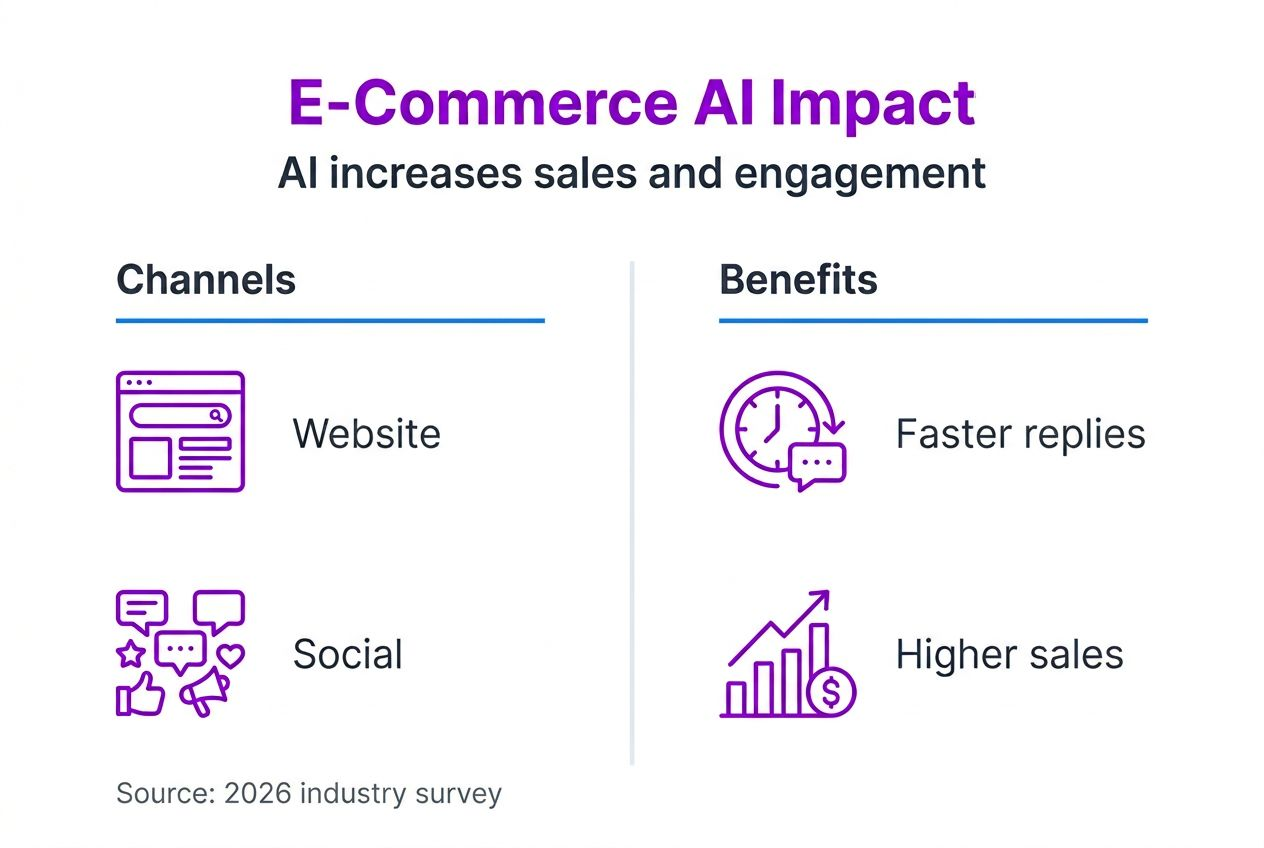
Customer engagement AI operates across multiple channels simultaneously:
- Web chat widgets embedded directly on your store
- Messaging apps like WhatsApp and Facebook Messenger
- Social media platforms including Instagram
- Email support through Gmail integration
This multi-channel capability ensures customers reach you through their preferred communication method. The AI maintains conversation context when shoppers switch between channels, creating seamless experiences that drive higher satisfaction and conversion rates.
The technology learns from every interaction. Machine learning algorithms identify patterns in customer questions and refine responses over time. Your chatbot becomes smarter without manual updates, continuously improving accuracy and relevance.
How AI chatbots improve sales and support efficiency
AI chatbots deliver measurable improvements across both sales conversion and support operations. Stores implementing these systems see conversion rate increases of 10-15% as chatbots guide shoppers through product discovery and purchasing decisions in real time.
Response time improvements stand out as the most immediate benefit. Traditional support teams take minutes or hours to respond during peak periods. AI chatbots answer in under 60 seconds regardless of query volume, eliminating the frustration that drives cart abandonment.
Support process efficiency gains reach 30% through automation of repetitive tasks:
- Order status lookups completed instantly without agent involvement
- Return and exchange requests processed automatically
- Coupon codes applied during conversations to close sales
- Product recommendations personalized based on browsing history
Consider the efficiency differences between traditional and AI-powered support:
| Metric | Traditional Support | AI Chatbot Support |
|---|---|---|
| Average response time | 5-15 minutes | Under 60 seconds |
| Simultaneous conversations | 1-3 per agent | Unlimited |
| After-hours availability | Limited or none | 24/7 coverage |
| Routine query handling | Manual process | Automated 70% |
| Ticket volume reduction | Baseline | 89% fewer tickets |
The efficiency gains compound over time. As your store grows, AI scales effortlessly while human teams require proportional hiring. A well-implemented chatbot workflow handles thousands of daily interactions at costs far below traditional support models.

Pro Tip: Track your chatbot’s performance weekly during the first month. Monitor resolution rates, escalation patterns, and customer satisfaction scores to identify optimization opportunities early.
Support teams report significant quality-of-life improvements when AI handles routine queries. Agents focus on complex situations requiring human judgment, reducing burnout and improving job satisfaction. This shift transforms support from a cost center into a strategic advantage.
Common misconceptions about customer engagement AI
Many e-commerce owners hesitate to adopt AI chatbots due to misconceptions about capabilities and implementation complexity. Understanding reality versus myth helps you make informed decisions about automation investments.
Myth: AI replaces all human support agents
Reality: AI handles routine queries while escalating complex issues to humans. Chatbots recognize when customers need empathy, creative problem solving, or authority to make exceptions. Your support team becomes more effective by focusing on high-value interactions rather than repetitive questions.
Myth: Setting up AI chatbots requires advanced coding skills
Reality: Modern platforms provide visual builders and pre-configured templates that eliminate coding requirements. You drag and drop conversation flows, customize responses, and connect backend systems through simple interfaces. Most stores complete basic deployments in hours, not weeks.
Myth: AI responses sound robotic and generic
Reality: Today’s natural language processing creates personalized interactions based on customer data and context. Chatbots reference previous purchases, acknowledge loyalty status, and adapt tone to match your brand voice. Personalization actually increases average order values as AI suggests relevant products.
Myth: Only large enterprises can afford AI chatbot technology
Reality: SaaS platforms democratized access to enterprise-grade AI capabilities. Pricing scales with your business size, offering free tiers for small stores and professional features as you grow. Implementation costs dropped dramatically compared to custom-built solutions from five years ago.
Setting realistic expectations improves implementation success. AI chatbots excel at structured tasks with clear answers but struggle with nuanced negotiations or emotionally charged situations. Designing your automation workflow around these strengths maximizes value while avoiding frustration.
Multi-channel AI chatbot strategies for e-commerce
Your customers expect to reach you through their preferred communication channels. Deploying AI chatbots across multiple platforms ensures you meet shoppers wherever they browse and message.
Successful multi-channel strategies integrate chatbots on:
- Facebook Messenger for social commerce interactions
- WhatsApp for international customers and personalized support
- Instagram for product discovery and purchase assistance
- Website chat widgets for immediate on-site engagement
- Gmail for email support automation
Stores using multi-channel approaches see engagement increases up to 20% compared to single-channel deployments. Shoppers appreciate flexibility to switch between channels without repeating information or losing conversation context.
Channel strategy impacts different customer segments uniquely:
| Channel Type | Primary Benefit | Best Use Case |
|---|---|---|
| Website widget | Immediate purchase support | Product questions during browsing |
| Messenger/WhatsApp | Conversational engagement | Post-purchase support and re-engagement |
| Visual product discovery | Lifestyle brands and fashion retailers | |
| Detailed inquiry handling | Complex issues requiring documentation |
Consistency across channels builds trust and recognition. Your chatbot should maintain the same personality, knowledge base, and capabilities regardless of where customers initiate contact. This unified experience reinforces brand identity while simplifying management.
Pro Tip: Start with your highest-traffic channel and one messaging app popular with your audience. Prove value before expanding to additional platforms, allowing you to refine workflows based on real usage patterns.
Seamless channel switching proves particularly valuable during complex customer journeys. A shopper might discover products on Instagram, ask questions via Messenger, then complete purchase through your website widget. AI maintains context throughout, creating frictionless experiences that boost conversion rates.
Integration simplicity matters when selecting your AI platform. Look for solutions offering pre-built connectors to major messaging services and e-commerce platforms. Native integrations reduce setup time and ensure reliable performance across all channels.
Practical implementation of customer engagement AI
Deploying AI chatbots successfully requires systematic planning and phased rollout. Follow these steps to implement customer engagement AI without overwhelming your team or customers.
- Evaluate your business needs for automation
Analyze support tickets and sales interactions to identify repetitive queries consuming the most time. Common candidates include order tracking, return policies, product specifications, and shipping information. Prioritize automating high-volume, low-complexity interactions first.
- Select a GDPR-compliant AI chatbot platform
Choose solutions offering multi-language support, data privacy controls, and explicit consent management. Compliance protects your business legally while building customer trust. Verify the platform supports your e-commerce system, whether Shopify, WooCommerce, or Magento.
- Deploy using no-code visual builders
Modern platforms let 90% of stores implement chatbots without coding through drag-and-drop interfaces. Start with pre-built templates for common scenarios like order status checks or product recommendations. Customize responses to match your brand voice and policies.
- Integrate with backend systems
Connect your chatbot to order management, inventory, and customer databases. Real-time integration enables actions like retrieving order status, applying coupon codes, or checking product availability. These capabilities transform chatbots from information providers to transaction facilitators.
- Configure human escalation rules
Define clear triggers for transferring conversations to support agents. Common escalation scenarios include customer frustration indicators, requests for refunds beyond policy limits, or technical issues requiring specialist knowledge. Smooth handoffs preserve customer satisfaction during complex interactions.
- Monitor and optimize performance continuously
Track metrics like resolution rate, customer satisfaction scores, and conversation completion rates. Review unresolved queries weekly to identify knowledge gaps or workflow improvements. AI learns from corrections, so regular optimization compounds effectiveness over time.
Pro Tip: Launch your chatbot to a small customer segment first. Gather feedback for two weeks before full deployment, catching issues while impact remains limited. This phased approach reduces risk and builds internal confidence.
Implementation timelines vary by complexity, but most stores achieve basic functionality within one week. Advanced workflows handling order modifications or product returns may require additional integration time. Start simple and expand capabilities as you validate value and build expertise.
Training requirements prove minimal compared to traditional software implementations. Your team focuses on conversation design and business rule configuration rather than technical programming. This accessibility makes AI chatbots practical for stores of all sizes.
Privacy and compliance considerations
Customer trust depends on transparent, compliant data handling practices. AI chatbots collect conversation data, purchase history, and personal information that require careful protection under regulations like GDPR.
Privacy compliance starts with explicit consent. Your chatbot should clearly explain data collection purposes and obtain customer permission before storing personal information. Provide easy opt-out mechanisms and honor deletion requests promptly to maintain regulatory compliance.
Key compliance requirements for e-commerce chatbots include:
- Data minimization: collect only information necessary for service delivery
- Secure storage: encrypt customer data both in transit and at rest
- Access controls: limit data access to authorized personnel only
- Retention policies: delete conversation data after defined periods
- Breach notification: establish procedures for reporting security incidents
Customers increasingly value privacy protection. More than 70% prefer chatbots handling data transparently, making compliance both a legal requirement and competitive advantage. Stores demonstrating strong privacy practices build loyalty and reduce customer acquisition costs.
Multi-language support extends beyond translation to cultural sensitivity around data privacy. European customers expect explicit GDPR compliance, while other regions have varying expectations. Adapting your chatbot’s privacy messaging to regional norms shows respect and builds trust with international audiences.
Compliance reduces legal risks that could devastate small businesses. GDPR violations carry fines up to 4% of annual revenue, making prevention essential. Choosing platforms with built-in compliance features shifts regulatory burden from your team to experienced providers.
Regular audits ensure ongoing compliance as regulations evolve. Review your chatbot’s data handling quarterly, updating consent flows and privacy policies as needed. Proactive compliance management prevents violations before they occur.
Bridging understanding to business outcomes
Investing in customer engagement AI delivers measurable improvements across your entire e-commerce operation. Conversion rate lifts of 10-15% translate directly to revenue growth without proportional cost increases. AI handles volume spikes during promotions or seasonal peaks that would otherwise require temporary staffing.
Support efficiency gains free human agents for high-value activities. Instead of answering “Where’s my order?” repeatedly, your team focuses on resolving complex issues, building customer relationships, and identifying product improvement opportunities. This shift transforms support from reactive cost center to proactive business intelligence source.
Improved responsiveness enhances customer satisfaction and lifetime value. Shoppers receiving instant, accurate answers complete purchases more often and return for future orders. The 24/7 availability AI provides captures sales from international customers in different time zones who would otherwise abandon carts.
Scalability proves particularly valuable for growing stores. Traditional support requires hiring and training new agents as volume increases. AI chatbots handle exponential growth in conversations without additional investment, protecting margins as revenue scales. This cost structure makes expansion more profitable and sustainable.
Competitive advantage accrues to early adopters who master AI engagement before rivals. Customers compare experiences across stores, favoring retailers offering instant, personalized service. Implementing AI now positions your store ahead of competitors still relying on manual processes.
Explore AI engagement solutions to grow your e-commerce store
Ready to transform customer engagement and boost sales through AI automation? The Agenized platform provides turnkey chatbot solutions designed specifically for e-commerce stores. Deploy AI agents that handle sales inquiries, automate support tickets, and guide customers from discovery to purchase across all channels.
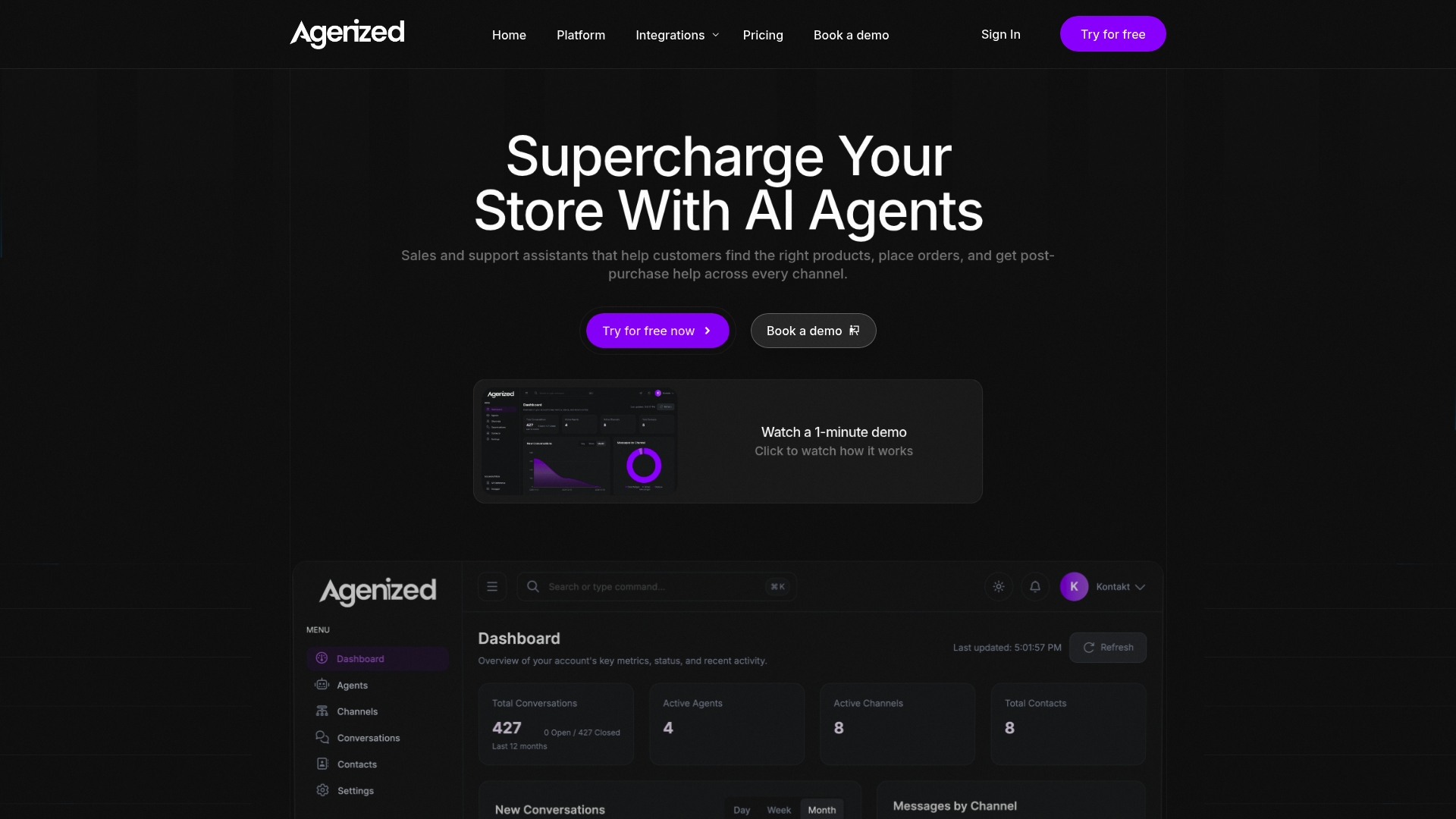
Explore proven workflows that increase conversions while reducing support costs. Visual builders and customizable templates make implementation accessible without coding expertise. Start with pre-configured agents for common scenarios, then expand capabilities as you identify additional automation opportunities.
The platform integrates seamlessly with Shopify, WooCommerce, and Magento stores. Connect your existing systems to enable real-time order lookups, inventory checks, and coupon applications directly through chatbot conversations. Step-by-step implementation guides walk you through deployment from initial setup to advanced optimization.
Discover how AI-powered engagement transforms customer experiences and business results. Join successful e-commerce stores already using Agenized to scale personalized service, increase sales, and build lasting customer relationships.
Frequently asked questions
What is customer engagement AI?
Customer engagement AI uses natural language processing and machine learning to automate personalized interactions between your e-commerce store and shoppers. These systems handle routine inquiries, guide product discovery, execute actions like order lookups, and escalate complex issues to human agents. The technology operates across multiple channels including website chat, Messenger, WhatsApp, and Instagram, maintaining conversation context as customers switch between platforms.
How do AI chatbots improve e-commerce sales and support?
AI chatbots increase sales conversions by 10-15% through instant product recommendations and purchase assistance. Response times drop to under 60 seconds regardless of query volume, eliminating frustration that causes cart abandonment. Support efficiency improves by 30% as AI automates routine tasks, allowing human agents to focus on complex situations requiring empathy and creative problem solving.
Can I implement AI chatbots without coding skills?
Most modern AI platforms provide visual builders and pre-configured templates that eliminate coding requirements. You design conversation flows through drag-and-drop interfaces, customize responses to match your brand, and connect backend systems using simple configuration screens. 90% of small-to-medium stores complete basic deployments without technical expertise, often launching functional chatbots within one week.
Are AI chatbots safe and compliant with privacy laws?
Reputable AI platforms include GDPR compliance features like explicit consent management, data encryption, and customer deletion requests. Privacy-respecting chatbots build trust with over 70% of customers who value transparent data handling. Choosing compliant platforms shifts regulatory burden from your team to experienced providers, reducing legal risks while maintaining customer confidence.
What channels should I use for AI chatbot engagement?
Deploy chatbots across multiple channels including website widgets, Facebook Messenger, WhatsApp, Instagram, and email support. Multi-channel strategies increase customer engagement by up to 20% compared to single-channel approaches. Start with your highest-traffic channel and one popular messaging app, then expand as you prove value and refine workflows based on actual usage patterns.








One thought on “Customer engagement AI boosts e-commerce sales by 15% in 2026”
Comments are closed.