Modern e-commerce customers expect instant answers, day or night. Studies show 24/7 AI customer support can increase conversion rates by up to 30% while reducing response times to seconds. This guide explains how AI-powered support works, why it matters for your online store, and how to implement it successfully in 2026.
Table of Contents
- Introduction To 24/7 Customer Support AI
- How 24/7 AI Customer Support Works
- Benefits Of 24/7 AI Customer Support For E-Commerce
- Common Misconceptions About 24/7 AI Customer Support
- Key Features Of Effective 24/7 AI Support Solutions
- Framework For Choosing 24/7 AI Customer Support Solutions
- Practical Implementation Considerations And Case Studies
- Summary And Next Steps For E-Commerce Store Owners
- Explore Agenized AI Solutions For E-Commerce Success
Key takeaways
| Point | Details |
|---|---|
| Instant response advantage | AI delivers answers in seconds, dramatically improving customer satisfaction and capturing more sales opportunities around the clock. |
| Proven sales impact | E-commerce stores using AI support see conversion increases up to 30% while automating 70% of routine queries. |
| Human collaboration essential | AI handles most interactions, but 10-20% of complex cases still require human agent escalation for optimal results. |
| Multi-channel capability | Deploy consistent support across website chat, WhatsApp, Messenger, Instagram, and email for seamless customer experience. |
Introduction to 24/7 customer support AI
24/7 AI customer support refers to automated assistance systems that use artificial intelligence to help customers anytime, without human intervention for most interactions. For e-commerce stores, this technology transforms how you serve shoppers, answer questions, and close sales.
Why does this matter? Your customers shop at midnight, on weekends, and during holidays. Traditional support teams can’t cover every hour without massive costs. AI bridges this gap affordably.
The core technologies powering 24/7 AI support include:
- AI chatbots: Automated conversational interfaces that engage customers in natural dialogue
- Natural language processing (NLP): Technology enabling bots to understand context and intent beyond simple keywords
- Machine learning: Systems that improve response accuracy over time by learning from interactions
These technologies work together to deliver personalized, contextual responses that feel human. Modern AI-powered support for e-commerce operates across multiple channels including your website, messaging apps like WhatsApp and Messenger, and social platforms like Instagram.
Crucially, AI augments your human team rather than replacing it. Think of AI as your first responder handling routine queries instantly, while escalating complex issues to human experts. This collaboration maximizes efficiency and customer satisfaction.
For practical examples of how e-commerce stores deploy AI successfully, explore support agent examples for ecommerce success. The shift to SaaS AI agents for e-commerce makes this technology accessible without heavy upfront investment.
How 24/7 AI customer support works
Understanding the mechanics helps you evaluate solutions effectively. AI support operates through several interconnected processes.
Natural language processing interprets what customers actually mean, not just the words they type. When someone asks “Where’s my stuff?”, NLP recognizes this as an order tracking request despite informal phrasing. This contextual understanding powered by NLP enables natural conversations.
Machine learning continuously improves performance. Each interaction trains the system to recognize patterns and refine responses. After handling thousands of “shipping time” questions, the AI learns regional variations and adapts answers accordingly.
The operational workflow typically follows these steps:
- Customer initiates conversation through any connected channel
- AI analyzes the query using NLP to determine intent
- System retrieves relevant information from your store database
- Bot generates personalized response based on customer history and context
- If query exceeds AI capability threshold, seamless escalation to human agent occurs
- All interactions feed back into machine learning model for improvement
Multi-channel integration means one AI system serves customers wherever they reach out. A shopper can start a conversation on your website, continue it via WhatsApp, and receive consistent help throughout.
Escalation mechanisms ensure smooth handoffs. When AI detects frustration, complex technical issues, or explicit requests for human help, it transfers the conversation with full context. Your human agents see the entire chat history and can pick up seamlessly.
For detailed process flows, review the AI agent workflow for e-commerce guide. The system learns continuously, getting smarter with every customer interaction.
Benefits of 24/7 AI customer support for e-commerce
The business case for AI support rests on measurable improvements across key metrics. Real data shows significant advantages.
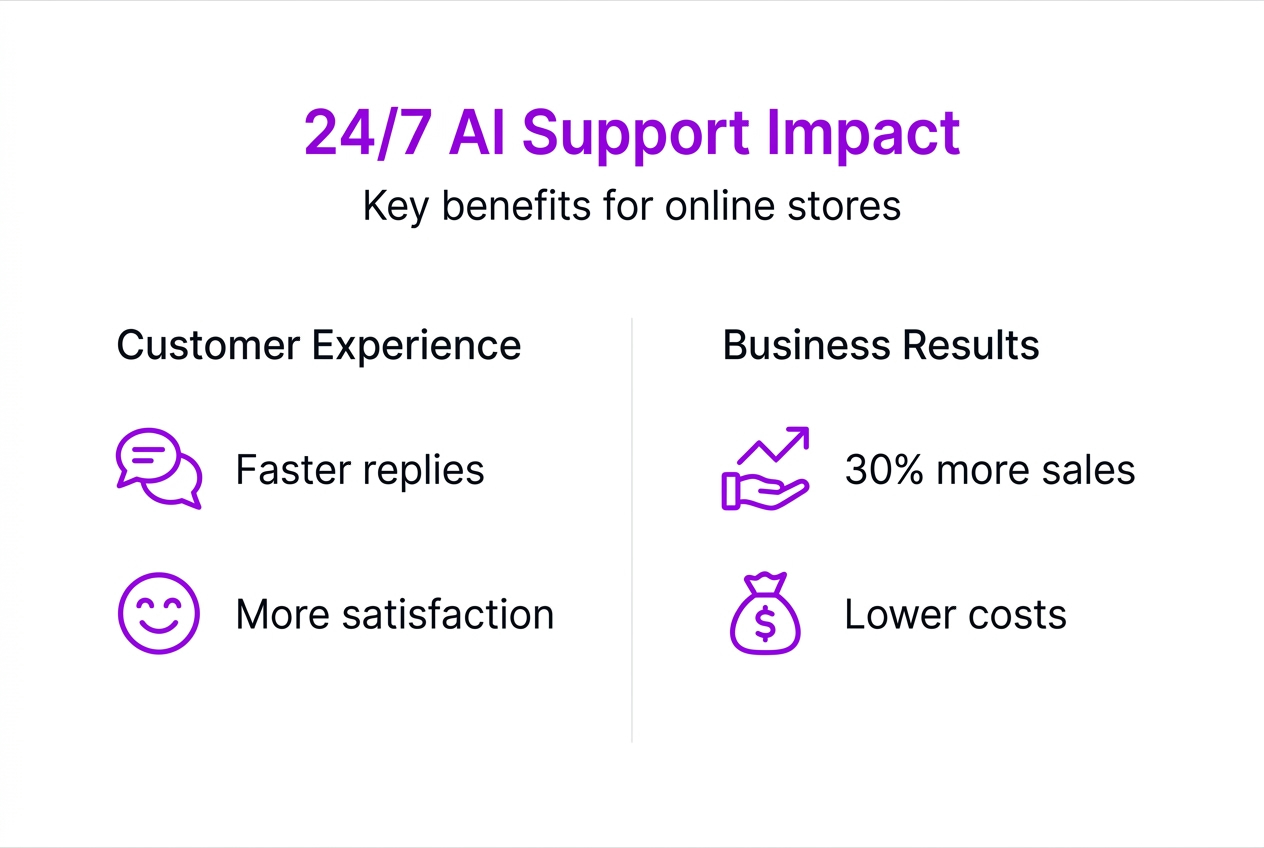
Response time drops from minutes or hours to seconds. Customers get instant answers, which directly impacts their buying decisions. Speed matters enormously in e-commerce where competitors are one click away.
Conversion rates can increase up to 30% when shoppers receive immediate, personalized assistance. Quick answers to product questions, size guidance, and checkout help remove friction from the buying process. This impact is documented in AI boosts e-commerce sales 30% research.

Cost savings accumulate quickly. AI handles up to 70% of common queries automatically, reducing the need for large support teams. You still need human agents for complex cases, but far fewer than traditional models require.
Customer satisfaction scores typically improve by about 20%. Consistent, accurate answers delivered instantly create positive experiences. Customers appreciate getting help on their schedule, not yours.
Scalability becomes effortless. During peak shopping periods like Black Friday or holiday rushes, AI handles volume spikes without wait times or additional hiring. Your support capacity scales instantly.
Cart abandonment decreases when shoppers get quick help during checkout. Confusion about shipping costs, return policies, or payment options gets resolved immediately, keeping purchases on track.
For implementation strategies, see boost sales with AI chatbots. The home page showcases how leading stores achieve these results.
Common misconceptions about 24/7 AI customer support
Clearing up misunderstandings helps set realistic expectations. Several myths persist about AI capabilities.
Myth: AI will completely replace human agents. Reality shows 10-20% of customer interactions require human expertise for optimal resolution. Complex returns, technical troubleshooting, and emotionally charged situations benefit from human empathy. The winning model combines AI efficiency with human judgment.
Myth: AI only handles simple, scripted responses. Modern NLP enables sophisticated, personalized interactions. Advanced systems understand context, remember conversation history, and adapt responses to individual customers. They’re not simple decision trees.
Myth: Customers don’t trust AI support. Research shows customers prefer fast, accurate answers regardless of source. What they dislike is getting stuck with an unhelpful bot. When AI provides clear value and offers easy human escalation, trust remains high.
Myth: AI can’t personalize experiences. Machine learning enables deep personalization based on purchase history, browsing behavior, and past interactions. AI can recommend products, adjust tone, and tailor responses more consistently than humans handling hundreds of daily conversations.
Pro Tip: Balance automation with a strong human fallback policy. Train your AI thoroughly, but make escalation to human agents obvious and frictionless. This combination maximizes satisfaction while maintaining efficiency.
For balanced perspectives, review the AI-powered support guide which addresses both capabilities and limitations realistically.
Key features of effective 24/7 AI support solutions
Choosing the right platform requires understanding essential capabilities. Not all AI solutions deliver equal value.
Multi-channel deployment ensures customers reach you through preferred platforms:
- Website chat widgets integrated directly into product and checkout pages
- Messaging apps including WhatsApp, Facebook Messenger, and Instagram Direct
- Email support for asynchronous conversations
- SMS for time-sensitive updates and quick queries
Real-time action capabilities separate basic chatbots from powerful support agents. Look for systems that execute tasks like order tracking, coupon application, account updates, and inventory checks without human intervention.
Customization options matter enormously. You need control over conversation flows, branding, tone, and specific workflows matching your business processes. Generic bots feel impersonal and miss sales opportunities.
Multi-language support opens international markets. Quality AI translates naturally, not word-by-word, maintaining context and cultural appropriateness across languages.
GDPR and privacy compliance must be built in, not added later. With international customers, data protection regulations are non-negotiable. Verify certifications before committing.
Seamless escalation processes preserve customer experience during handoffs. Context transfer, conversation history, and clear status communication ensure smooth transitions.
| Feature | AI Support | Human-Only Support | Rule-Based Chatbots |
|---|---|---|---|
| Availability | 24/7 instant | Limited hours | 24/7 but rigid |
| Personalization | High, learns over time | High but inconsistent | Low, scripted only |
| Scalability | Unlimited | Expensive to scale | Unlimited but limited capability |
| Complex issue handling | Escalates to humans | Full capability | Cannot handle |
| Cost efficiency | High ROI | High ongoing cost | Moderate |
Pro Tip: Prioritize platforms with easy integration and flexible customization to future-proof your AI support. Business needs evolve, and your system should adapt without complete rebuilds.
Explore multi-channel AI support options and see how customer engagement AI boosts sales. Review comprehensive AI support platform features to compare capabilities.
Framework for choosing 24/7 AI customer support solutions
A systematic evaluation process prevents costly mistakes and ensures the solution fits your specific needs.
-
Assess customization capabilities. Test how easily you can modify conversation flows, adjust responses, and create custom workflows. Rigid systems become frustrating quickly.
-
Evaluate integration breadth. Verify the platform connects with your e-commerce system (Shopify, WooCommerce, Magento), CRM, email tools, and preferred messaging channels. Fragmented systems create data silos.
-
Test NLP sophistication. Challenge the AI with varied, informal queries. Can it handle misspellings, slang, and ambiguous requests? Poor NLP frustrates customers.
-
Verify multi-language quality. If you serve international markets, test translations in your target languages. Machine translation quality varies significantly.
-
Confirm compliance certifications. Request documentation of GDPR, CCPA, or other relevant data protection compliance. This isn’t optional for global e-commerce.
-
Examine escalation workflows. Understand exactly how and when conversations transfer to humans. Clunky handoffs damage customer experience.
-
Review analytics and reporting. You need visibility into performance metrics, common questions, escalation rates, and customer satisfaction to optimize continuously.
-
Calculate total cost of ownership. Look beyond monthly fees to implementation time, training requirements, and ongoing maintenance needs.
For step-by-step guidance, consult the AI agent workflow evaluation resource. The AI platform assessment page provides comparison frameworks.
Practical implementation considerations and case studies
Real-world deployment involves specific challenges and timelines. Learning from others’ experiences accelerates your success.
Typical integration requires 3-6 months for full optimization. Initial setup takes weeks, but training the AI and refining workflows demands ongoing attention. Rushing this phase compromises results.
GDPR compliance affects every design decision. You must:
- Clearly disclose AI usage to customers
- Obtain proper consent for data collection
- Enable data deletion requests
- Restrict data sharing and storage appropriately
- Document processing activities
One fashion retailer implemented AI support and saw a 40% reduction in cart abandonment within four months. The bot answered sizing questions instantly, compared products, and provided real-time shipping estimates during checkout. Sales increased while support costs dropped.
Balancing automation level with human backup determines success. Over-automation frustrates customers stuck with unhelpful bots. Under-automation wastes the technology’s potential. The sweet spot typically lands at 70-80% automation.
Common implementation challenges include:
- Insufficient training data causing poor initial performance
- Ignoring human fallback design until customers complain
- Compliance oversights creating legal exposure
- Inadequate performance monitoring missing optimization opportunities
| Implementation Phase | Timeline | Key Challenge | Mitigation Strategy |
|---|---|---|---|
| System integration | 2-4 weeks | Technical compatibility issues | Verify integrations before purchase |
| Initial AI training | 4-6 weeks | Limited historical data | Supplement with competitor analysis |
| Beta testing | 2-3 weeks | Identifying edge cases | Test with diverse customer scenarios |
| Full deployment | 1-2 weeks | User adoption | Communicate benefits clearly |
| Optimization | Ongoing | Measuring effectiveness | Establish KPIs and review monthly |
Pro Tip: Continuously monitor AI performance metrics and iterate based on customer feedback. Set up weekly reviews during the first three months, then shift to monthly once stable.
Learn from the AI chatbot success story showcasing measurable results.
Summary and next steps for e-commerce store owners
24/7 AI customer support delivers measurable benefits including faster response times, higher conversion rates, and significant cost savings. The technology combines AI efficiency with essential human oversight for complex situations.
Key capabilities to prioritize include multi-channel deployment, real-time action execution, sophisticated NLP, and seamless human escalation. GDPR compliance and customization flexibility ensure long-term viability.
Successful implementation requires:
- Assessing your specific support needs and customer expectations
- Researching vendors using the evaluation framework provided
- Planning a phased integration with adequate training time
- Establishing clear performance metrics and monitoring processes
- Maintaining strong human agent backup for complex cases
Start with a pilot project on one channel before expanding. This approach limits risk while proving value.
Your next steps:
- Audit current support performance to establish baseline metrics
- Define success criteria specific to your business goals
- Shortlist 3-5 AI platforms matching your requirements
- Request demos and test NLP capabilities with real queries
- Calculate ROI projections based on realistic automation percentages
- Plan implementation timeline with adequate training periods
For comprehensive guidance, visit the agenized homepage to explore proven solutions designed specifically for e-commerce success.
Explore agenized AI solutions for e-commerce success
Ready to implement 24/7 AI customer support that actually delivers results? Agenized provides purpose-built AI agents designed specifically for e-commerce stores like yours.
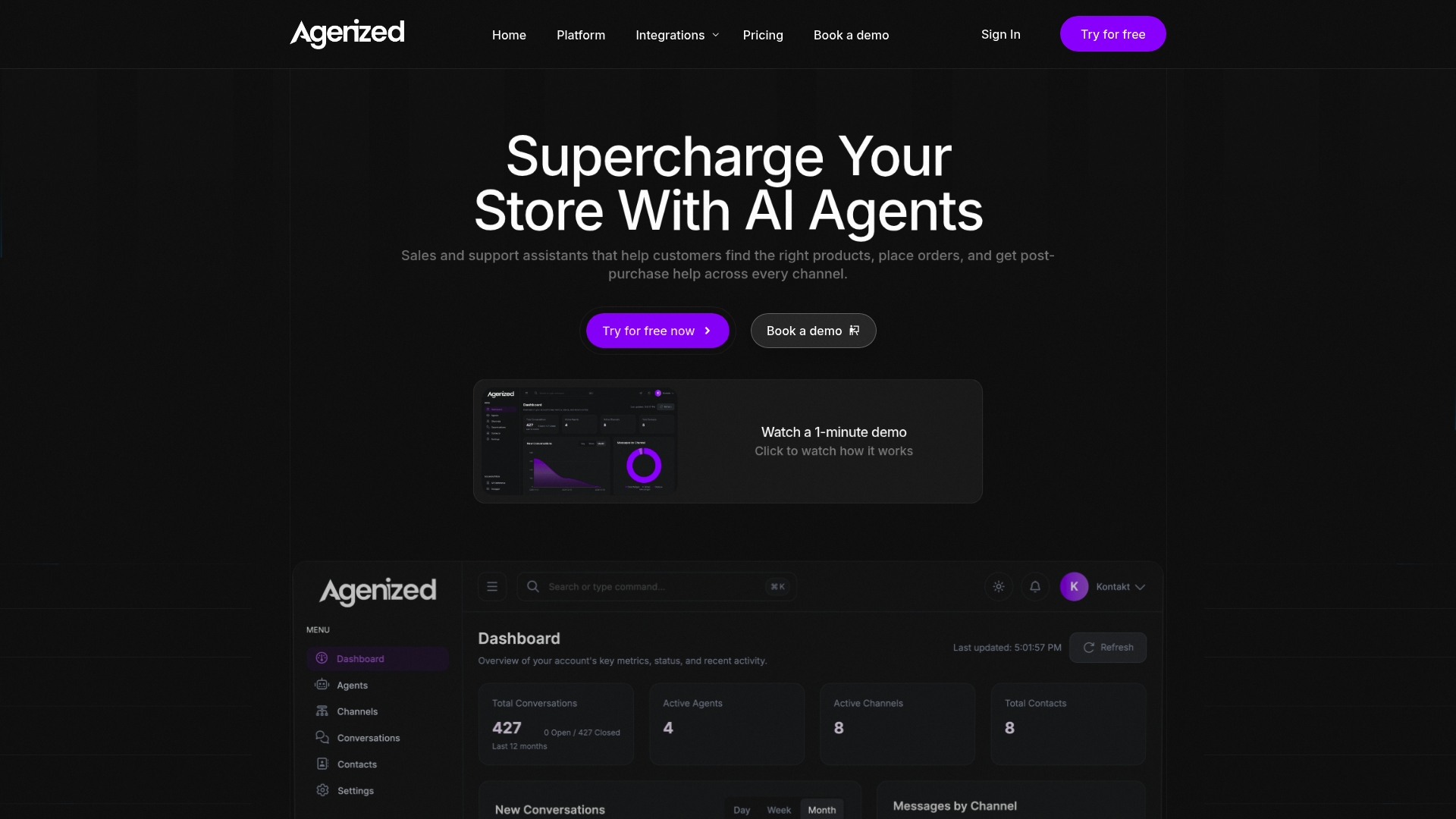
Our platform handles the complexity while you focus on growth. Deploy across website chat, WhatsApp, Messenger, and Instagram with one unified system. Execute real-time actions including order tracking, coupon application, and inventory checks automatically.
Stores using Agenized report conversion increases matching the 30% industry benchmark while automating over 70% of support queries. GDPR compliance comes built in, not bolted on.
Explore the agenized AI support platform to see customization options and integration capabilities. Review the complete AI agent workflow for e-commerce to understand implementation steps. Learn how to boost sales with AI chatbots through proven strategies.
FAQ
How does 24/7 AI customer support improve e-commerce sales?
AI enables instant responses and personalized product recommendations that reduce friction in the buying process. This immediate assistance decreases cart abandonment and captures sales opportunities that would otherwise be lost during off-hours when human agents aren’t available.
Can AI customer support fully replace human agents?
No, AI handles 70-80% of routine queries efficiently, but 10-20% of interactions require human expertise for complex issues, emotional situations, or unique requests. The optimal model combines AI automation with strategic human escalation for best results.
What are the main challenges when implementing 24/7 AI customer support?
Training AI systems requires 3-6 months of optimization to achieve peak performance. Ensuring GDPR compliance demands careful attention to data handling and customer consent. Maintaining clear human fallback processes prevents customer frustration when AI reaches its limits.
How does multi-channel AI support enhance the customer experience?
Serving customers across website chat, WhatsApp, Instagram, and other platforms ensures they get help through their preferred communication method. Multi-channel AI provides consistent, context-aware responses regardless of where the conversation starts, creating seamless experiences that boost satisfaction.