Modern e-commerce faces a critical challenge: converting browsers into buyers while maintaining exceptional support. AI in product discovery boosts e-commerce sales 30%, transforming how online retailers engage customers. AI-powered chatbots now handle everything from personalized recommendations to post-purchase support across multiple channels. They work 24/7, speak multiple languages, and escalate complex issues to human agents seamlessly. This guide reveals how retailers leverage AI to enhance customer experience, reduce cart abandonment, and drive measurable revenue growth.
Table of Contents
- Introduction To AI In E-commerce Sales
- How AI Enhances Customer Experience In E-commerce
- Multi-Channel Sales Optimization Through AI Chatbots
- Common Misconceptions About AI In Sales And Customer Support
- Quantifying The Impact Of AI Chatbots On Sales
- Framework To Understand And Implement AI In E-commerce Sales
- Case Studies And Real-World Applications With Agenized
- Practical Considerations And Next Steps For E-commerce Retailers
- Explore Agenized AI Solutions For E-commerce Success
- Frequently Asked Questions
Key takeaways
| Point | Details |
|---|---|
| AI chatbots dramatically improve conversion rates | AI in product discovery boosts e-commerce sales 30% through personalized engagement and instant support. |
| Multi-channel integration expands customer reach | AI chatbots deployed across Messenger, WhatsApp, Instagram, and websites create consistent experiences that increase engagement. |
| Hybrid AI-human models deliver best results | Combining automated responses with human escalation maintains service quality while reducing operational costs. |
| Visual builders accelerate deployment speed | Modern platforms cut implementation time by 50%, enabling faster time-to-market for AI sales solutions. |
| Data-driven metrics prove tangible ROI | Reduced cart abandonment, faster transaction times, and higher repeat purchase rates demonstrate clear business value. |
Introduction to AI in e-commerce sales
AI chatbots represent intelligent software agents that simulate human conversation to assist online shoppers throughout their purchasing journey. These digital assistants integrate directly into e-commerce platforms, handling customer inquiries, recommending products, processing orders, and resolving support issues without human intervention. Their role extends beyond simple FAQ responses to active sales participation.
The sales functions AI chatbots enhance include:
- Product discovery and personalized recommendations based on browsing behavior and purchase history
- Real-time customer support answering questions about inventory, shipping, and policies
- Order processing assistance including cart recovery, coupon application, and order management workflow guide
- Post-purchase support handling returns, exchanges, and tracking inquiries
Adoption trends show remarkable growth in 2026. Retailers recognize that AI in product discovery boosts e-commerce sales 30%, making AI chatbots essential rather than optional. Platforms like Shopify, WooCommerce, and Magento now offer native integrations, simplifying deployment for stores of all sizes.
Integration spans critical e-commerce channels. AI chatbots operate on websites through embedded widgets, connect with social platforms like Instagram and Facebook Messenger, and extend to messaging apps including WhatsApp and Gmail. This multi-channel presence ensures customers receive consistent support regardless of their preferred communication method.
How AI enhances customer experience in e-commerce
Personalization stands as AI’s most powerful customer experience tool. AI chatbots analyze browsing patterns, purchase history, and demographic data to suggest products tailored to individual preferences. These recommendations feel intuitive rather than intrusive, guiding shoppers toward items they genuinely want. AI in product discovery boosts e-commerce sales 30% by reducing decision fatigue and presenting relevant options at optimal moments.
Round-the-clock availability transforms customer support economics. Traditional support teams operate during business hours, leaving international customers and late-night shoppers waiting. AI chatbots answer questions instantly at 3 AM or across time zones, maintaining engagement when human agents sleep. This constant availability directly correlates with higher satisfaction scores and reduced cart abandonment.
Human escalation remains critical for complex scenarios. AI excels at routine inquiries but recognizes when issues require human judgment. Support agent examples for e-commerce demonstrate how AI identifies frustrated customers, technical problems, or nuanced requests and seamlessly transfers conversations to live agents with full context.
Cart abandonment rates drop significantly with AI intervention. When shoppers hesitate at checkout, AI chatbots proactively offer assistance, address concerns about shipping costs or return policies, and apply targeted discounts. This real-time intervention recovers sales that would otherwise vanish. Repeat purchase metrics improve as AI remembers customer preferences and proactively suggests reorders or complementary products.
Pro Tip: Configure your AI chatbot to trigger cart recovery messages 30 minutes after abandonment, when purchase intent remains high but obstacles need addressing.
The step by step AI agent workflow shows how these elements combine into cohesive customer journeys that feel natural rather than automated.
Multi-channel sales optimization through AI chatbots
Customers expect seamless experiences across every platform they use. AI chatbots meeting this expectation deploy simultaneously on websites, social media, and messaging apps, creating unified brand presence. A shopper might discover products on Instagram, ask questions via Messenger, and complete purchase on the website, with AI maintaining conversation context throughout.

Multi-platform AI chatbot integration increases engagement by 20% by meeting customers where they already spend time. Instead of forcing shoppers to your website for every interaction, AI extends your sales presence to WhatsApp conversations, Instagram DMs, and Facebook Messenger. This convenience reduces friction and accelerates purchase decisions.
Multi-language capability expands global reach without proportional cost increases. AI chatbots fluent in Spanish, French, Mandarin, and other languages serve international markets with the same quality as English speakers receive. This localization opens revenue streams from regions previously too expensive to support with human agents.
Real-time actions during conversations demonstrate AI’s sales power:
- Retrieving order status and tracking information instantly
- Applying discount codes or promotional offers based on conversation context
- Updating cart contents or modifying orders without leaving the chat interface
- Scheduling delivery windows or processing returns on the spot
| Feature | Agenized AI Platform | Generic AI Chatbots |
|---|---|---|
| Multi-channel deployment | Native support for Messenger, WhatsApp, Instagram, Gmail, website widgets | Limited to 1-2 channels, requires custom integration |
| Real-time actions | Execute orders, apply coupons, retrieve data live | Mostly informational responses |
| Customization | Pre-built templates for sales and support roles | Generic one-size-fits-all approach |
| Human escalation | Smart detection with full context transfer | Manual switching, lost conversation history |
| Compliance | GDPR-compliant data handling built-in | Requires separate compliance configuration |
The AI chatbot platform features and multi-channel AI support ecommerce resources detail how integrated platforms outperform fragmented solutions.
Common misconceptions about AI in sales and customer support
Myth 1: AI fully replaces human support teams. Reality shows hybrid models combining AI efficiency with human judgment deliver superior results. AI chatbots complement human agents and improve service efficiency by 40% by handling routine inquiries while escalating complex issues. This division lets humans focus on high-value interactions requiring empathy or creative problem-solving.
Myth 2: AI guarantees complete automation immediately. Successful deployment requires phased rollout. Start with defined use cases like FAQ responses or order tracking, measure performance, refine responses based on actual conversations, then expand gradually. Expecting instant full automation leads to disappointing results and customer frustration.
Myth 3: AI works identically across all platforms. Each channel presents unique constraints and user expectations. Instagram users expect visual, concise responses. Email customers tolerate longer, detailed explanations. WhatsApp conversations feel casual and immediate. Customization matching each platform’s culture ensures natural interactions.
Myth 4: AI only benefits sales, not support. This false dichotomy ignores how support quality directly impacts sales. Customers hesitating over shipping policies or return procedures need support to complete purchases. Post-sale support handling order issues builds loyalty driving repeat purchases. Support agent roles in AI sales demonstrates this interconnection.
Myth 5: Generic AI solutions work as well as specialized platforms. E-commerce presents specific requirements around product catalogs, inventory systems, payment processing, and order management. SaaS AI agents benefits explain why platforms purpose-built for retail outperform general chatbot builders.
Quantifying the impact of AI chatbots on sales
Hard data reveals AI’s tangible business value. Studies measuring conversion rate improvements consistently show 15-30% increases after AI chatbot deployment. These gains stem from instant question answering, personalized recommendations, and proactive cart recovery that keeps shoppers engaged through purchase completion.
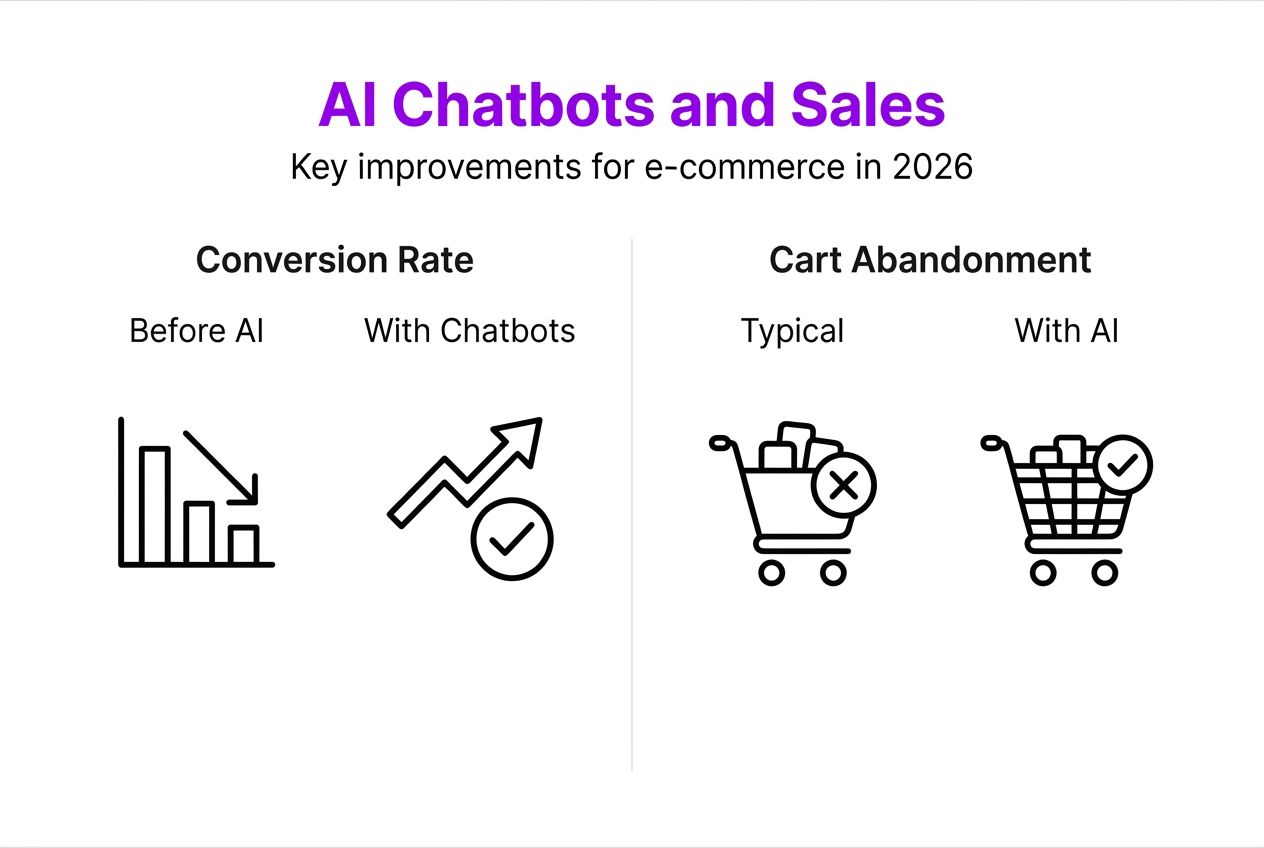
Cart abandonment rates, typically 60-80% across e-commerce, drop 10-25 percentage points with AI intervention. The difference represents recovered revenue that would otherwise disappear. Transaction times decrease as AI guides customers efficiently through product selection and checkout without waiting for human agent availability.
| Metric | Before AI Chatbots | After AI Chatbots | Improvement |
|---|---|---|---|
| Sales conversion rate | 2.5% | 3.25% | +30% |
| Cart abandonment rate | 70% | 52% | -18 points |
| Average transaction time | 8 minutes | 5 minutes | -37.5% |
| Repeat purchase rate (90 days) | 22% | 31% | +41% |
| Customer satisfaction score | 3.8/5 | 4.4/5 | +16% |
Repeat purchase frequency climbs as AI remembers preferences and proactively suggests relevant products. Customer satisfaction scores improve when shoppers receive instant, accurate responses regardless of contact time. These metrics translate directly to revenue growth and reduced customer acquisition costs.
Visual chatbot builders reduce AI deployment time by up to 50%, enabling faster realization of these benefits.
“The speed at which retailers can now deploy sophisticated AI chatbots has transformed from months to weeks. Visual builders and pre-configured templates eliminate traditional technical barriers, letting marketing teams launch AI agents without extensive developer involvement.”
The AI agent workflow for ecommerce success provides frameworks for tracking these metrics systematically.
Framework to understand and implement AI in e-commerce sales
Three conceptual layers organize AI chatbot functionality. The customer engagement layer handles initial contact, product discovery, and relationship building through personalized conversations. The sales funnel layer guides shoppers from browsing to purchase, addressing objections and simplifying checkout. The operational automation layer manages post-purchase support, returns, tracking, and repeat order facilitation.
Implementation follows structured steps ensuring successful deployment:
- Assess current customer journey pain points through analytics and support ticket analysis
- Define specific use cases where AI delivers immediate value, such as size recommendations or shipping policy questions
- Select a platform offering e-commerce-specific features including inventory integration and order management
- Configure AI responses using visual chatbot builders that cut technical barriers and speed AI agent deployment by up to 50%
- Test thoroughly with internal teams before customer-facing launch
- Deploy to limited customer segment, monitoring conversations and satisfaction
- Iterate based on actual interactions, expanding AI capabilities and channels progressively
- Measure KPIs including conversion rates, support ticket reduction, and customer satisfaction scores
GDPR and privacy compliance cannot be afterthoughts. AI chatbots handle personal data, purchase history, and payment information requiring robust security. Ensure your platform provides data encryption, compliant storage, clear privacy policies, and customer consent mechanisms built into the conversation flow.
Pro Tip: Begin with two high-volume, low-complexity use cases like order tracking and return policy questions. Perfect these before expanding to complex product recommendations or technical support.
| Feature | Agenized | Generic Platforms |
|---|---|---|
| E-commerce templates | Pre-built sales and support agents ready for customization | Build from scratch |
| Visual workflow builder | Drag-and-drop conversation design | Code-based configuration |
| Platform integrations | Native Shopify, WooCommerce, Magento connections | API-only integration |
| Deployment speed | Launch in days | Weeks to months |
| GDPR compliance tools | Built-in consent management and data controls | Manual implementation required |
The multi-channel AI support ecommerce guide and siteagent.ai alternatives 2026 comparison help evaluate platform options.
Case studies and real-world applications with Agenized
Agenized clients demonstrate measurable success across diverse retail categories. A fashion retailer using customizable sales agent templates increased average order value by 23% through AI-powered outfit recommendations and styling suggestions. The chatbot analyzed purchase history and browsing behavior to suggest complementary items, mimicking personal shopper expertise at scale.
Multi-channel deployment proved critical for a home goods store. By activating AI agents across Instagram, website widget, and WhatsApp simultaneously, they captured customer inquiries regardless of platform preference. Engagement rates increased 34% as shoppers received instant responses on their chosen channel.
Real-time action execution transformed operations for an electronics retailer. Their AI chatbot retrieves order status, applies promotional codes, and processes returns without human intervention. Support ticket volume dropped 47% while customer satisfaction scores climbed, proving automation enhances rather than degrades experience.
Multi-language support opened international markets for a beauty products seller. Their AI chatbot fluent in English, Spanish, and French served North American and European customers equally well. International sales grew from 12% to 31% of total revenue within six months, expansion previously impossible without prohibitive hiring costs.
GDPR compliance features built into Agenized allowed European retailers to deploy AI confidently. Automated consent collection, data retention controls, and transparent privacy policies satisfied regulatory requirements while maintaining conversational fluency.
Hybrid AI-human workflows balance efficiency with quality. The Agenized platform features include intelligent escalation detecting when conversations require human judgment. This seamless handoff preserves conversation context, preventing customers from repeating information.
Practical considerations and next steps for e-commerce retailers
Technical deployment complexity has diminished dramatically. Modern AI chatbot platforms offer visual builders, pre-configured templates, and native e-commerce integrations. Retailers without developer resources successfully launch AI agents in days rather than months. Visual chatbot builders cut technical barriers and speed AI agent deployment by up to 50%, democratizing access beyond enterprise retailers.
Key performance indicators require upfront definition and consistent tracking:
- Conversion rate changes pre and post-AI deployment
- Cart abandonment rate reduction
- Average response time for customer inquiries
- Support ticket volume decrease
- Customer satisfaction scores through post-interaction surveys
- Revenue per visitor improvements
Human-AI collaboration best practices maximize both efficiency and quality. Train support teams to handle escalated conversations AI identifies as complex. Use AI conversation logs to identify common questions requiring better product information or website clarity. Let AI handle repetitive inquiries while humans focus on relationship building and creative problem-solving.
Phased rollout builds organizational confidence and customer trust. Launch AI for specific functions like FAQ responses or order tracking. Monitor performance, gather feedback, refine responses. Expand to product recommendations once initial functions perform reliably. Add channels progressively rather than attempting simultaneous multi-platform launch.
Pro Tip: Monitor customer feedback intensely during the first 30 days. Quick iterations based on real conversations dramatically improve AI performance and prevent negative impressions from cementing.
The AI agent workflow for ecommerce and why choose SaaS AI agents resources provide detailed implementation guidance.
Explore Agenized AI solutions for e-commerce success
Agenized specializes in AI-powered sales and support agents purpose-built for online retailers. The platform eliminates traditional deployment barriers through visual builders, customizable templates, and native integrations with Shopify, WooCommerce, and Magento. Deploy AI chatbots across websites, Messenger, WhatsApp, Instagram, and Gmail from a unified dashboard.
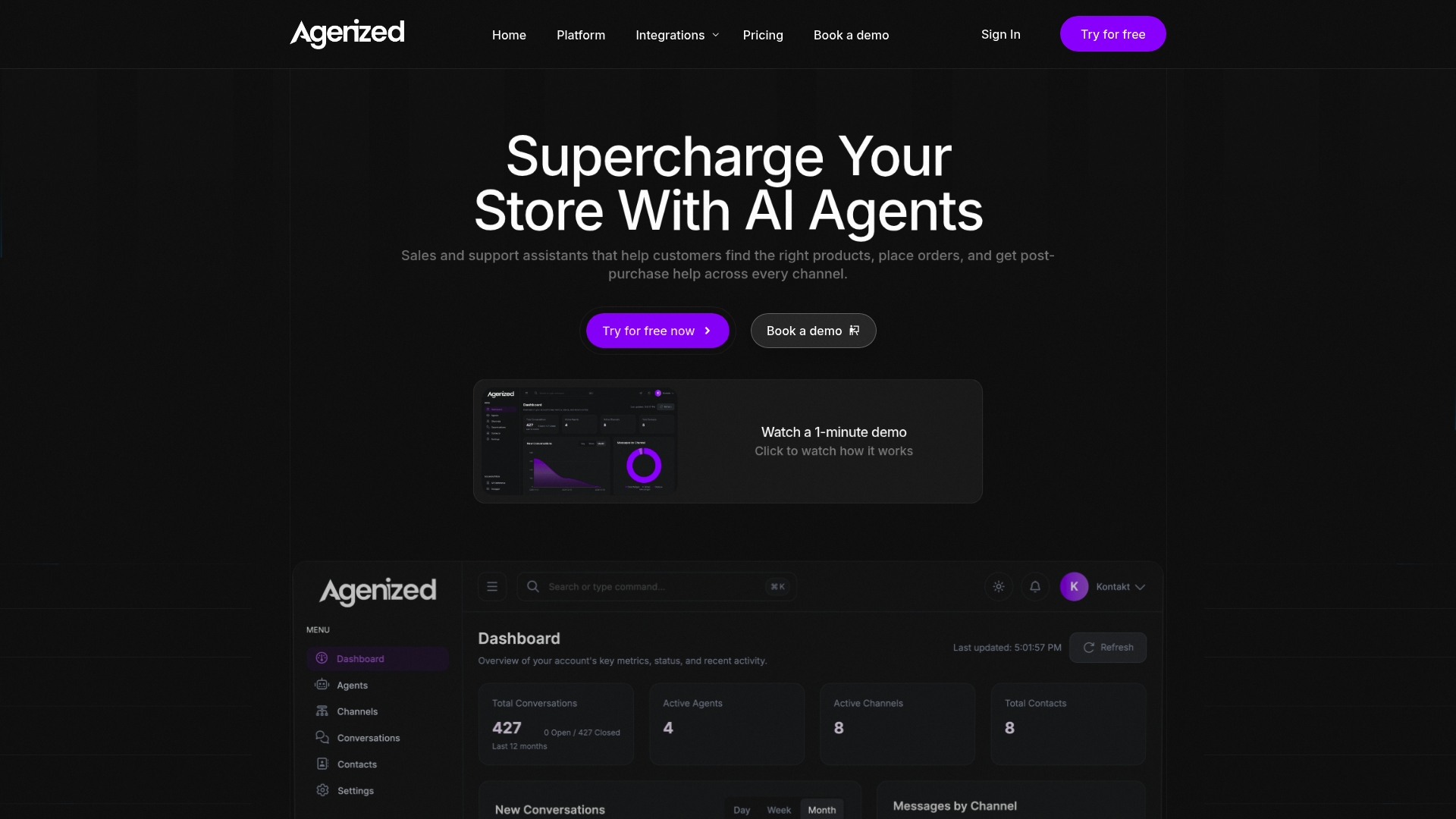
Multi-channel capability ensures consistent customer experiences regardless of contact point. GDPR-compliant data handling and built-in consent management address privacy requirements without custom development. Real-time action execution including order retrieval, coupon application, and return processing transforms AI from informational to transactional.
Explore the complete AI agent workflow for ecommerce success showing how Agenized chatbots guide customers from discovery through post-purchase support. The Agenized platform offers free and professional tiers scaling with business growth. Discover how multi-channel AI support expands reach and engagement across every customer touchpoint.
Frequently asked questions
What is the role of AI in sales for e-commerce?
AI chatbots automate customer interactions throughout the sales funnel, from product discovery to checkout completion. They provide personalized recommendations, answer questions instantly, and proactively address objections that might prevent purchase. SaaS AI agents benefits include 24/7 availability and multi-language support expanding market reach.
How do AI chatbots improve customer engagement?
AI delivers instant responses eliminating wait times that frustrate shoppers and cause abandonment. Personalized interactions based on browsing history and preferences make recommendations feel tailored rather than generic. Multi-channel presence meets customers on their preferred platforms, reducing friction in the buying process.
Can AI chatbots fully replace human customer support?
No, hybrid models combining AI efficiency with human judgment deliver best results. AI handles routine inquiries like order status or return policies, freeing humans for complex issues requiring empathy or creative problem-solving. Smart escalation ensures customers reach human agents when conversations exceed AI capabilities.
What metrics prove AI chatbot effectiveness in e-commerce?
Conversion rate increases of 15-30%, cart abandonment reductions of 10-25 percentage points, and improved customer satisfaction scores demonstrate tangible value. Transaction time decreases and repeat purchase rate improvements also indicate successful AI deployment. Track these KPIs consistently to measure ROI.
How quickly can retailers deploy AI chatbots?
Modern platforms with visual builders and pre-configured templates enable deployment in days rather than months. Technical barriers have diminished, allowing marketing teams to launch AI agents without extensive developer involvement. Phased rollout starting with specific use cases accelerates time-to-value while managing risk.
What compliance considerations apply to AI chatbots?
GDPR and privacy regulations require transparent data handling, customer consent mechanisms, and secure storage. Choose platforms with built-in compliance tools including consent collection, data retention controls, and clear privacy policies. AI chatbots handling payment information need additional security measures ensuring encrypted transactions.